(This blog post is a reprint of a piece in the CFHA Blog from January 15th, 2015. Click here for the original post. Reprinted with permission.)
In primary care, more than half of the office visits are for somatic complaints, which are often associated with depression and anxiety. These conditions often go undetected and can have a significant impact on health outcomes. As providers adopt a collaborative approach to care, many have incorporated the use of assessments for screening and early detection of symptoms of mental health and substance use conditions.
With an abundance of assessments, measures, and tools available for use, many collaborative care practices are challenged with determining which are most effective for use in the limited time available during a routine office visit. Screenings are important for all age groups. Below is a list of the top ten tools for use in practices. These ten were selected based on a number of factors, including reliability, validity, sensitivity, efficiency, and cost. In most cases, the tools are available for use at no cost. Most are also available in multiple languages as well.
PHQ-9: The Patient Health Questionnaire (9) is widely used among primary care providers to identify depression. With only nine questions, this tool is easy to use and has been validated for early detection.
AUDIT: The Alcohol Use Disorders Identification Test is a 10-item questionnaire developed by the World Health Organization and is found to be very effective in primary care settings.
GAD-7: The seven-item General Anxiety Disorder screening identifies whether a more complete assessment is needed.
DAST-10: The Drug Abuse Screen Test is a brief 10-item self-report tool that is effect for screening adults and adolescents for drug abuse.
PC-PTSD: This four-item screen is effective for detecting post-traumatic stress disorder in primary care settings.
Pediatric Symptoms Checklist: The 17-item version is easy to use in family practices for detecting developmental and behavioral problems.
SBQ-R: The Suicide Behaviors Questionnaire is a four-question scale for assessing suicide-related thoughts and behaviors.
Brief Pain Inventory: The tool is widely used in medical settings for assessing pain, and is available in 23 languages.
Insomnia Severity Scale: This seven-question screening assessment is effective in identifying problems with sleeping.
MDQ: The Mood Disorder Questionnaire (MDQ) is a 13-item questionnaire used to screen for bipolar disorder symptoms.
In order to limit the list to ten, there are many excellent tools that did not make this list. For example, some providers prefer the CAGE-AID to the AUDIT-7 for alcohol screening. In addition, many will find it very useful to have additional tools on hang to screen for additional conditions, such as:
Geriatric depression
Eating disorders
Postpartum depression
Intimate partner violence
ADHD
Autism
Integrating these tools into your electronic health record, including them in patient kiosks, and/or instructing support staff to make select tools available for completion while in the reception area are ways in which these cools have been included in practices. With routine use of many of these screening tools, collaborative care practices will efficiently and effectively detect signs and symptoms of behavioral health conditions. This enables earlier intervention, resulting in better health outcomes.
When Bob Dylan wrote this iconic song, many felt that it captured the spirit of social and political upheaval of the 1960s, much in the same way that we view mental health as “a-changin’.” And these changes require mental/behavioral health providers to change the manner in which they deliver services.
Reports over the past decade have brought attention to the current mental health crisis:
In addition, over the past few years far too many catastrophic events have brought attention to this mental health crisis, resulting in a public outcry, demanding that changes are made to prevent future tragedies.
But change isn’t easy.
The relatively brief history of community mental health services has been a challenging one. Just a few months ago, as we celebrated the 50th anniversary of President John F. Kennedy’s signing the Community Mental Health Bill into law, the conversations quickly progressed to the subject that is on the minds of virtually all behavioral health providers—and an unusually large number of the general public and policy makers, given the historical lackluster interest in the topic—mental health is in dire need of change.
The economic downturn in the US in 2008 resulted in massive budget cuts in all but a few states. The March 2011 NAMI report, State Mental Health Cuts: A National Crisis, demonstrated the cumulative cut to mental health services in the U.S. during that time was nearly $1.6 billion. Community mental health services plummeted from being barely adequate to the critical point in many states. Safety-net providers were forced to close programs due to the slashed budgets. Many of those affected ended up on the streets or in jail.
The recent announcement on the anniversary of the Sandy Hook tragedy, of the planned infusion of dollars into help repair our broken mental health system, is encouraging. However, the entire mental health system is in dire need of an overhaul. One that looks at the broader healthcare picture and strategically plans for mental health and substance use disorder treatment to be included. A person-centered, whole health approach to treatment is necessary for improving the patient experience of care; improving the health of populations; and reducing the per capita cost of health care: the Triple Aim.
Dale Klatzker, PhD
Dr. Dale Klatzker knows that, although it isn’t easy, change is vital for community behavioral health providers.
It’s exciting to be able to offer a look at integrated care from the perspective of a provider, particularly a provider who has demonstrated leadership excellence in integrating behavioral health and primary care services. Dr. Klatzker currently serves as the Chief Executive Officer of The Providence Center in Providence, Rhode Island. He has been a leader in behavioral healthcare for more than 35 years. Since becoming president/CEO of The Providence Center in 2004, Dr. Klatzker, a visionary, has transformed the system of care, quality of service delivery, and social policy decision making at The Providence Center and the state of Rhode Island. Click here for Dr. Dale Klatzker’s bio.
The Providence Center and the Providence Community Health Centers have created a successful partnership to meet the whole-health needs of the people they serve within their community; a need that is clearly outlined in the literature. According to the Robert Wood Foundation’s Mental Disorders and Medical Comorbidity authored by Dr. Benjamin Druss and Elizabeth Walker, comorbidity between medical and mental conditions is the rule rather than the exception:
Dr. Klatzker:Change is a good thing. Most CMHCs haven’t changed a lot. They haven’t prepared themselves to change a lot and have marginalized themselves and the people that they serve by not being more a part of the mainstream. We have sets of skills that are integral to wellness and to health across a wide spectrum. We need to be proud of what we do, but also to expand it and extend it because this is the perfect time for this. We have a lot of things to offer that others are trying to replicate.
Things don’t stay static. You have to look though the windshield but also through the rear-view mirror. You have to know where you are but you also have to know where you’re going.
As executive director/CEO of a behavioral health organization, you have the obligation to push yourself, and that will push your organization, to do what is necessary so that your mission is reinforced but also to serve the needs of the community. It’s hard to do that if you’re doing the same thing you did 20 years ago. We do our consumers a disservice if we do that.
Person-centered approach to care
Dr. Klatzker: What we’ve embraced here – what’s part of the DNA of the organization at The Providence Center – we believe in a person-centered approach to care. No two people are exactly the same. The people that we work for deserve as much access to a wide array of both health and social supports as anyone. That’s how you have to guide yourself. When you’re thinking of those things, primary care integration, working much more toward the mainstream of traditional healthcare is imperative for us.(7:14)
What we’ve found is, if you can build those relationships and find the right connections, then others will embrace you and value you for what you bring to the table. In fact, we bring a lot. Partnership is always the first choice, the default.
We don’t chase dollars, we don’t create programs because it’s the idea du jour from some funder somewhere, we consciously look on our mission as our touchstone and build upon that to provide as much choice to the people we serve. We can be very person-centered because there aren’t many gaps in what we’re providing. (They provide a wider array of services than the average CMHC) We’ve consciously built out a wide array because we think it’s the right thing to do. Rather than to take a “no,” if we can’t partner, we build.
Example of a successful integrated care partnership
Dr. Klatzker: The Providence Center is closely connected to one the largest federally qualified health center in the state of Rhode Island, the Providence Community Health Center. We have become the largest community mental health center. Neither had a desire to replicate the services that the other provided. Over the years we’ve built this into a “no wrong door” integrated collaborative effort so that in the mental health center, the FQHC runs a full-service practice with 1100-1200 patients. In the FQHC, we are integrated in their physician practices building and we also have a separate section of their building where we provide longer term care and some other types of specialty care. We’ve integrated our records with each other. We meet frequently to process and to try to figure out how to make our care efficient and effective. We are working closely with them now on adopting our health home model to integrate a modified health home into the FQHC.
Yes, the times they are a-changin’. And so are healthcare providers. (At least the forward-thinking providers like The Providence Center.) They are heeding the findings from the numerous expert reports and research. They are thinking outside the box, adopting a person-centered approach that enables better outcomes for the many who place their trust in them—trusting them to take care of their whole-health needs.
“That’s the next direction that [organizations] need to go, bringing substance abuse back into the discussion. We need to go past just the integration of primary care and mental health care to a more Whole Person Care.”
Benjamin Druss, MD, MHP
It has been my pleasure to talk with Dr. Benjamin Druss for this edition of the Integrated Care Thought Leader Series. Having had the privilege to work with Dr. Druss on various integrated care projects over the past few years, I have come to respect not only his keen insight into what’s needed beyond the horizon for the care of people with behavioral health disorders, but the compassion and dedication he brings. His humility and brilliance are evident upon introduction; he’s a true visionary. Dr. Druss, my mentor and my friend, has provided inspiration to me in my work and outlook on the world of healthcare, integration, and beyond.
Dr. Druss, Dr. Silke von Esenwein, and their colleagues at Emory University are currently conducting an exciting NIMH research trial, The Health Outcomes Management and Evaluation (HOME) Study. As described on the website clinicaltrials.gov: There is an urgent need to develop practical, sustainable approaches to improving medical care for persons treated in community mental health settings, this study will test a novel approach for improving mental health consumers based on a partnership model between a Community Mental Health Center and a Community Health Center. When this study is completed, it will provide a model for a medical home for persons with severe mental illness that is clinically robust, and organizationally and financially sustainable.
Dr. Druss received his bachelor’s degree from Swarthmore College in 1985, earned his medical degree from New York University in 1989 and later his master’s in public health from Yale University in 1995.He is also board certified in psychiatry. He trained as a resident in general internal medicine at Rhode Island Hospital and in psychiatry at Yale University School of Medicine. Click here for more information about Dr. Benjamin Druss
Advancement in integrated care through the years
Dr. Druss was one of the first to address the physical health concerns among people with serious mental illness and substance use disorders, particularly among the public sector populations in urban regions. During our discussion on integrated care, he addressed areas of change over the past 18 years that has had the greatest impact on the advancement of healthcare for people with serious mental illness. He described the world of Health Information Technology as a frontier that, over the past 10 years, has resulted in changing policies and procedures in healthcare. These changes have had significant impact on the ability for healthcare organizations to share information, resulting in improved care for patients.
Dr. Druss advises that the next stage needed for healthcare is to begin “broadly looking at other social determinants of health.” The focus should be on an approach to healthcare that is person-centered. The concept of addressing population health and creating a system of care will be a more effective approach to improving health outcomes moving forward. He recommends that substance abuse must be brought back into the discussion, and to go past just the concept of integration of physical health and mental health, toward a more “whole person care” approach.
What do you foresee for the field as we move forward?
Dr. Druss: Clearly there’s going to be major changes in how care is delivered. I think there’s a lot of opportunity moving forward with new public sector models, Medicaid, patients with medical homes, and also the promise of new technologies moving forward as well.
I’m very optimistic; I think things will certainly be very different five years from now. We’re in a period where things are evolving very quickly and we don’t know exactly what the world will look like, but I think we can say that things will look different—and that things will look better.
Research has to change as well. I’m mostly a researcher and lot of what we’ve been doing is slow-paced. The slow-paced process by which we develop a model, and then test it over a five year period. You apply for a grant and then you test it for five years, then it’s another two years before it’s published. So we’re going to have to be looking for more ways for understanding data and evaluating programs. I think the new technologies will help, their more wide-spread availability will help. Just as the health system needs to change—and is changing—health research is going to need to change as well.
The funding agencies still are gradually coming to that point. NIMH has a new program that they are looking to fund that looks at natural experiments out in the community. So I think that’s the sort of research that we’re going to need to see more of in the coming years—good, careful, thoughtful evaluations of some of the demonstration projects going on out in the community.
What barriers to integration to you currently see?
Dr. Druss: I’d say that a lot of community mental health centers are still on this part of the learning curve in terms of learning about integration, such as how potential partner organizations work, [such as] Federally Qualified Health Centers. [CMHC’s] often lack information technology infrastructure that makes it easier to do the work. There are some places, some community clinics, and other organizations that are out in front on these issues, that are early adopters, and there’s some that are trying to figure it out and hopefully will learn from the experience of those organizations that are further ahead.
Thank you, Dr. Druss, for your dedication to improving the health and quality of life of so many who live with serious behavioral health conditions.
Be sure to check back soon for our next Thought Leader, Larry Fricks, pioneer in the Peer Support movement.
A sampling of Dr. Druss’s cutting-edge research and other publications are listed below:
Co-Principal Investigator, Robert Wood Johnson Foundation; Funding Period 9/1/96-1/31/98
“Chronic Illness, Disability, and Managed Care”
Principal Investigator, National Association for Research in Schizophrenia and Affective Disorders (NARSAD); Funding period July 1, 1996 – June 30, 1998
“Work and Health Care Costs associated with Depression Compared with Chronic General Medical Illnesses”
Principal Investigator, Donaghue Medical Research Foundation; Funding period July 1, 1996-Decmeber 31, 1999
“Costs of Depression for an Employed Population”
Principal Investigator, NARSAD; Funding Period July 1999-June 2001
“Treatment of Depression and Medical Illness Under Managed Care: Understanding the Differences”
Principal Investigator, NIMH K08 Mentored Clinical Scientist Award; Funding Period January 1999-December 2004
“Impact of Depressive Disorders in Health and Work Settings”
Principal Investigator, Robert Wood Johnson Foundation; Funding Period October 1, 2004-September 30, 2006
“Evidence-Based Management of Depression in Public-Sector Primary Care”
Principal Investigator: R34MH78583; Funding Period September 1, 2006-August 1, 2010
“Adapting a Medical Self-Management Program for a Community Mental Health Center”
Principal Investigator: K24MH075867; Funding period July 2006-June 2011
“Mending the Safety Net: Improving Linkages between CHCs and CMHCs”
Principal Investigator, AHRQ R18; Funding Period September 2008-September 2012
“An Electronic Personal Health Record for Mental Health Consumers”
Principal Investigator R21HS017649; Funding Period August 1st 2008-April 2010
“Mental Comorbidity and Chronic Illness in the National Medicaid System”
Principal Investigator, NIMH R01; Funding period August 2004-April 2014
“Improving Primary Care for Patients with Mental Disorders”
Principal Investigator NIMH MH090584-01A1; Funding Period 06/15/2011- 03/31/16
“A peer-led, medical disease self-management program for mental health consumers”
The poll generated a tremendous amount of interest, both in voting on the poll and in comments. Much has happened in the healthcare industry in the past twelve months, changes that have an impact on the way behavioral health and primary care will be delivered in the future.
The greatest impact has come from the Patient Protection and Affordable Care Act (ACA) that was upheld by the Supreme Court of the United States on June 28, 2012. Though passed in 2010, the flurry of activity toward implementing began after the Supreme Court ruling. As states prepare for the 2014 implementation of the new health laws, more and more are agreeing to participation in the Medicaid Health Home plan.
Poll Results
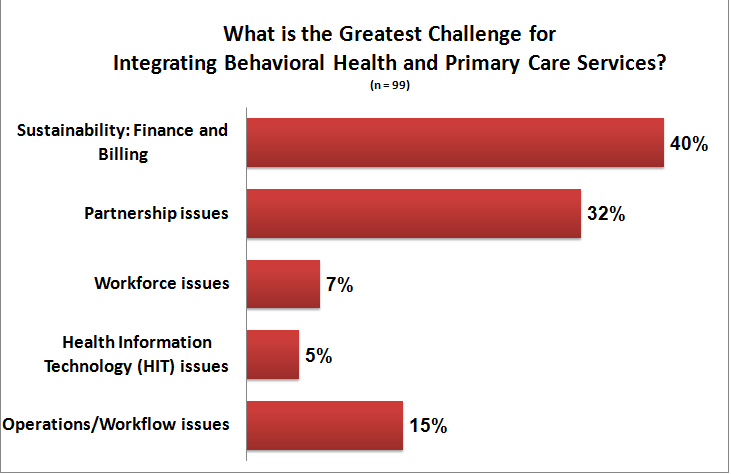
As we near the end of the first quarter 2013, time is running out quickly for implementation. With integrated care playing a crucial role in health reform, the challenges for integrating healthcare services are more and more apparent. Revisiting the below results of the poll conducted one year ago, one has to wonder whether the perceived challenges remain the same among healthcare providers.
Poll results from LinkedIn group, Behavioral Health Integration 3/5/2012 – 3/5/2013
Finance and Billing
Poll responses indicated that sustainability issues related to finance and billing were the greatest challenge for integration efforts. While many providers have successfully overcome this barrier, it is no easy feat to develop a financially sustainable integrated services delivery system. Fortunately, the ACA created an optional Medicaid State Plan benefit for states to establish Health Homes to coordinate care for people with chronic conditions who receive Medicaid benefits. While only a handful signed on initially, there are currently 24 states and the District of Columbia who have elected to participate in the Medicaid Expansion. Fourteen states have elected not to participate; and 12 states remain undecided. (Click here for more information on where each state stands on ACA’s Medicaid expansion.)
States that are moving forward with Medicaid Health Homes are in the process of making adjustments to policies, billing, and service delivery to enable service providers to integrate behavioral health and primary care services, a requirement of Health Homes:
Regular visitors to this blog know that much has been published here about the partnership between behavioral health and primary care providers. This was ranked as second most challenging in the poll.
Why do so many people find partnership issues as challenging? It’s counterintuitive. Most providers approach the integration of behavioral health and primary care with a blind eye to the process of partnership development. It is assumed that the interpersonal aspects will fall into place. Unfortunately, it is far more likely that an integration effort will fail due to partnership issues than financial ones. They are not unlike other partnerships, requiring attention to building a strong foundation from the onset.
All healthcare administrators acknowledge the importance of operations for successful service delivery. That’s why 15% of respondents to the poll indicated that this area is the greatest challenge. Once a smooth-running clinic takes on an entirely new service-line, a degree of disruption is inevitable. The workflow will likely be drastically different than the service providers and support staff have grown accustomed to. Of course, taking on a new service also means addressing the organization’s policies, regulatory requirements, physical space requirements, etc.
With a little careful planning and a LOT of patience, your new integrated clinic will be operating smoothly in no time. Click here for a useful integration planning checklist.
Workforce Issues
Seven percent of the respondents indicated that workforce is the greatest challenge. With the current shortage of primary care providers, nurses, and psychiatrists, it’s no wonder that this is of concern. Fortunately, programs for training about integrated care delivery are available, such as the University of Massachusetts Medical School’s Center for Integrated Primary Care, which offers three programs aimed at training healthcare providers for providing integrated services:
Despite concerns over the dilemma of sharing health records for integrating behavioral health and primary care, health information technology garnered 5% of the responses. Fortunately vendors of electronic health records are working earnestly to develop products that allow for the seamless sharing of behavioral health and primary care records. (Click here for more information on the role of HIT in integrated healthcare.)
One Year Later
What are the greatest challenges to integrating behavioral health and primary care in 2013? What will be the challenges next year? Dare we suggest that in the near future there will no longer be challenges?
The CEO of the local Community Behavioral Health Center (CBHC) and the CEO of the local Community Health Center (CHC) bump into each other at a local community function. The conversation turns to a deliberation about healthcare integration. They plan to meet for lunch next week to discuss it further.
At lunch, they examine the latest healthcare trend: providers from behavioral health and primary care joining forces to form integrated healthcare partnerships to improve health outcomes. Both agree that theirs’ is a match made in heaven. Over dessert they decide to become partners, sealed with a firm handshake.
What happens next?
For a successful partnership, it is crucial to start with a solid foundation that includes flexibility in the core structure to weather the inevitable storms ahead. This must be accomplished before beginning to build. Failure to adequately address this will result in a partnership that appears to be healthy on the outside but with a weak core. Remember that it’s easy to have a good relationship during the good times. When troubles arise, the solid core serves as an anchor to enable perseverance. To accomplish this, there are key areas that must be discussed thoroughly before moving on to formalizing the partnership.
Why is this important?
Consider this version of the next chapter in the aforementioned scenario:
Over a series of phone calls, the two CEOs discuss the details of their lunchtime plan for partnering to to provide integrated healthcare. Topics discussed include creating a Memorandum of Understanding; financial arrangements (who pays for what); which services will be provided; and who bills for which services; becoming a health home. Separately, the CEOs meet with their management teams to plan logistics. At that point the leaders, thinking their work was done, withdrew from the planning.The management teams put together the clinical teams for providing the services. The various teams finally meet for a face-to-face planning session, roughly two weeks prior to the scheduled kickoff. The CEOs make a final appearance to give it their blessings.
The teams are thrust into the arranged marriage, virtual strangers. They never had the opportunity to establish a relationship before the partnership was finalized.
Shortly after the two year anniversary, the partnership is dissolved. The two CEOs think back to the dessert agreement with the “happily ever after” partnership they envisioned and, scratching their heads, wonder what happened.
Unfortunately too many partnerships follow the course outlined above. Once the relationship is dissolved, the organizations return to business as usual. However, it is the people who received the integrated services who are hurt as a result; once again left without services.
Some important things to consider for a successfully integrating behavioral health and primary care include the following:
Identifying the Vision and Mission
Locating a partner is an important first step. Before the partnership is formalized, however, it’s essential to carefully clarify the vision and mission to ensure that they are in alignment with the expectations of each of the organizations. Each partner must become very familiar with the other’s mission and vision. These questions will help to drive that discussion:
Are the potential partners prepared for taking on a new business venture?
Are the stated missions of the organizations in sync?
Can the long-term plans of each organization be adjusted to include this partnership?
Over the next few weeks we will examine critical steps to ensure that your partnership avoids the pitfalls that the organizations in the scenario encountered: A partnership that has the solid and flexible foundation that is necessary for a lasting partnership.
Next week we will take a look at the process of determining the level of integration that will best fit with your vision for the partnership.
HIT is critical to the success of health homes and healthcare integration, allowing behavioral health and primary care providers to share information. This sharing enables healthcare providers to have access to all available healthcare information related to the individual being served. And this, of course, results in improved health outcomes. The SAMHSA-HRSA Center for Integrated Health Solutions has a wide array of HIT resources: click here for more information.
The Past
Not too many years ago, healthcare providers were handwriting or dictating their progress notes. When patients were seen outside the office, or if the notes were not yet filed in the chart, the limited amount of information available created a challenge to providing the best care. A patient who was unable to provide a thorough medical history was being treated blindly in some regards. And health implications aside, numerous medical procedures were repeated due to lack of access to the reports. Duplication of the procedures drove up healthcare costs.
In addition, the sharing of information between providers was the exception rather than the rule. Coordination of care between providers for patients referred to specialty care was not reimbursed and, as a result of limited resources, less than ideal. This brief history lesson on medical records serves to illustrate the value of electronic health records and health information technology.
Fast Forward to the Present
Though far from ideal, the healthcare industry is making great strides in health information technology, including health information exchanges (HIEs) designed to facilitate the sharing of data. Despite the rapid progress, sharing information continues to be a challenge for behavioral health and primary care organizations. These integration efforts create unique challenges, largely due to problems with sharing information between two systems. The electronic health records (EHRs) used by primary care providers are seldom compatible with EHRs used by behavioral health providers. While some partnerships have implemented means of addressing this (work arounds), such as a third system to link the two or “home grown” alternatives, there are currently no ideal options available.
These noble community providers persevere however. They are well accustomed to dealing with challenges in the quest for pursuing their mission. People with serious mental illness are dying prematurely; and has been inadvertently perpetuated by this lack of information sharing. In an attempt to be respectful and responsible with healthcare information, limitations (and misunderstandings) have impeded information sharing. The Health Insurance Portability and Accountability Act of 1996 (HIPAA), Public Law 104-191 and Title 42: Public Health Part 2—Confidentiality of Alcohol and Drug Abuse Patient Records, also known as 42-CFR Part 2, are the most frequently cited reasons for not sharing information. These federal regulations cite guidelines for confidential health information. Though intended to provide clarity, healthcare organizations have interpreted the regulations very conservatively.
The Future
HIT has changed the face of healthcare and holds great promise for the future of behavioral health and primary care integration. Health information technology is not only providing cost-effective means of providing superior collaborative treatment, it is paving the way for reducing the health disparities for people with serious mental illness and other behavioral health conditions.
For the past few years, community behavioral health and primary care organizations have been working collaboratively to provide services for the people they serve, diligently trying to create the perfect formula for doing what is best for the healthcare needs of the people they serve, while at the same time striving to remain financially solvent. And they have done a remarkable job! But it isn’t easy…nor have their outcomes always been ideal, largely due to limited resources. Certainly not for lack of trying!
These benevolent community providers are charged with serving the most in need. This does not always translate into being adequately compensated for their efforts, however. While some have been forced to limit their services, most have managed to avoid rationing thus far through their persistence in seeking alternatives, such as creating referral agreements, co-locating, full integration, and with grant funding. In addition, many have engaged in advocating for change at the local, state, and national levels. These tenacious providers recognize that an unwavering focus on the mission is the foundation for success.
With the newly upheld Affordable Care Act, more people will have access to healthcare coverage and will not be rejected because of pre-existing conditions. Also, for the states that don’t opt out of the new Medicaid expansion, all residents below the 133 percent of the poverty line will be eligible for Medicaid coverage. Therefore, more of the people served by community providers who were previously uninsured will have healthcare coverage. This will allow the providers to be compensated for more of the services they provide, thus supporting the mission.
The ACA doesn’t provide all the answers but it is a move in the right direction. Politics aside, our healthcare system isn’t working the way it is. We need major changes. We already know that integrating behavioral health and primary care services is more economical and provides improved health outcomes. Through these health homes, individual care is coordinated. That just makes sense. The health home approach translates into better care for fewer healthcare dollars. This is a perfect opportunity to build on a successful model.
With our newly upheld Accountable Care Act at the cusp of our nation’s 236th birthday, it’s a perfect time to pull together and focus on building a system that allows us to provide effective services to meet the total healthcare needs of people with behavioral health concerns in this, the land of the free and the home of the (soon t0 be) healthy.
Every relationship follows a similar pattern. The early phase begins with the selection of a partner. The same holds true for the integrated behavioral health and primary care partnership. It may begin with running into each other at a meeting. Or perhaps while reading the latest report on the emerging trend of healthcare integration, Accountable Care Organizations, health homes, etc…
The VISION begins to form
The behavioral health and primary care clinics enter into the dating relationship when the leaders of each, who have mutual admiration for each other, begin to recognize the potential of doing business together. One leader calls the other, suggesting they get together for lunch. It’s only lunch, he rationalizes to himself, it doesn’t mean anything…there’s no harm just in talking…. One thing leads to another during the wooing and courting phase; soon the idea transitions and the outline of a plan begins to emerge. The two leaders have entered the early stages of the partnership. The Vision is being created, becoming a driving force for each. The two organizations soon find themselves having serious discussions about forming a partnership. How did THIS happen?? The proposal is followed with a flurry of planning. There are so many details! Attorneys are kept busy creating a business plan and reviewing financial and regulatory documents, planning for the wedding of two organizations. Decisions must be made of how the assets are to be shared. Finances are sorted, MOUs are signed, and the partnership is official. The marriage of behavioral health and primary care creates a unique entity that is far greater together than either had, or could have been, alone. The early stage of the partnership is filled with excitement as the Vision takes shape and becomes reality. The shared vision is driven by the passion to become what neither can achieve alone. The specialty behavioral health provider and the primary care provider have integrated, raising the bar of healthcare for people with behavioral health disorders.
This marriage of healthcare providers is based on a Vision shared by two of eliminating the health disparities of people who suffer from serious mental illness and substance use disorders.
COMMUNICATION
Early Phase: THE HONEYMOON
In the early days of the partnership, the Honeymoon phase, there is a distinct tendency toward assuming that both partners are speaking the same language and are working toward the same goals. The excitement of the new endeavor and the synergy created initially helps to move things along at a rapid pace. When the behavioral health partner talks about workflow and scheduling appointments, there is little thought given to the fact that these two concepts have VERY different meanings for the primary care provider. It is important to have a thorough review of operations from both perspectives and to find a viable middle-ground that both partners find acceptable. Making open, frequent communication a priority from the onset will prevent problems later on. This should include a thorough overview of each organization’s regulatory, financial, and operational processes as well as overall mission. Don’t assume that the two partners really understand how each other’s organization functions.
Problems within the Partnership (AKA THE HONEYMOON IS OVER!)
If the partners neglect to develop an open culture of communication on the front end, it is likely that miscommunication will develop. The Honeymoon phase is in jeopardy. The entrepreneurial partner fails to understand the ongoing delays from the partner with the extensive bureaucratic approval process that prevents a quick turnaround of virtually everything. As misunderstandings develop into disappointments and resentments, the previous harmony is disrupted. The Honeymoon is over. Internal conflicts must be addressed immediately with candor. This is a good time to have an open conversation about all the aforementioned points and develop a plan for ongoing, frequent communication. Concerns about the great divide over productivity targets, outcome measures, and caseloads must be openly discussed, among other important points of contention. By devoting the necessary focus on the importance of Communication, the partnership will successfully transition to the third key component for a successful behavioral health – primary care marriage, Compromise. The shared mission to reduce health disparities for the individuals served who suffer from comorbid behavioral health and medical conditions will persevere. However, failure to make this transition may very well land this promising partnership into divorce court.
COMPROMISE
I shall argue that strong men, conversely, know when to compromise and that all principles can be compromised to serve a greater principle. –Andrew Carnegie
It isn’t easy to bring a behavioral health organization and a primary care organization together for the creation of an integrated partnership, despite the reason–altruistic or otherwise. When partners fail to provide adequate attention to open and effective communication, the excitement of early marriage can wane; the relationship may become troubled, requiring mediation. When misunderstandings occur and tempers flare, it’s time for an intervention to get the partnership back on track.
Marital Counseling
As with any relationship, compromise is a necessary element in the behavioral health – primary care partnership. After the honeymoon phase, the partnership enters a crucial period in which its future is determined by the ability of the partners to negotiate the (sometimes rocky) path ahead. Differences between the two entities become more apparent as pressure mounts via the divergent audits, budgets, various regulatory requirements, etc. Furthermore, what are the partners to do when they encounter conflicting requirements? Marital counseling may be in order at this point. In other words, it’s time for the partners to take a time-out and take an honest and open appraisal. Developing shared solutions are important for strengthening the bond. The partners must approach all dilemmas together as a team. Each has a vested interest; negotiating solutions will strengthen that bond. Wise leaders recognize that trust is not automatically bestowed. Members of the teams need time and patience for trust to develop. By bringing together members from each team who share similar roles and encouraging ongoing, regular interaction, trust begins to develop within the partnership. Remember that trust cannot be rushed but will grow into a strong foundation throughout the partnering organizations if nurtured. Empowering the team provides the opportunity for everyone to develop a sense of ownership for successful outcomes. Empowered employs who feel that they play an important role in the organization and who feel valued by management have a greater sense of commitment to the organization. Allow team members the ability to make decisions rather than having every movement scripted. When the receptionist is empowered to work-in an emergency patient without having to gain approval for every occurrence, amazing things begin to happen: The receptionist feels like a valued member of the team, the patient benefits from the responsiveness, and the other members of the team benefit from the smooth workflow. In marriage, each partner has a responsibility for doing his/her part to ensure equilibrium. The same is true between andwithin the partnership.
Determine Expectations
Mentioning expectations at this point might seem unnecessary. After all, the behavioral health and primary care organization have formed the partnership for the distinct purpose of providing healthcare integration. It’s a very clear expectation and doesn’t require discussion. Or does it? Just as a couple contemplating marriage might wrongly assume that each has the same idea of what their marriage will be like (one partner daydreams about a trendy loft in the city while the other longs for a house with a massive lawn in the suburbs), the integrated healthcare partnership can fall into the same trap of flawed thinking. Don’t assume! The chances for happily ever after increase exponentially when time and effort are committed for open discussions about expectations for the partnership. Both partners must be willing to compromise on expectations when they are incongruent. And don’t forget:
People with serious mental illness are dying while we try to figure this out!
OUTCOMES
With individuals who suffer from serious mental illnesses dying 25 years prematurely on average, behavioral health and primary care have been mandated to address this health disparity. More effective protocols are in order and must be initiated immediately. This is a matter of life and death. The Behavioral Health and Primary Care Marriage is a viable solution.
Growing Old Together
Once the marriage has successfully navigated the first three essential components of a behavioral health – primary care marriage, Vision, Communication, and Compromise, the final component builds and maintains the mature partnership for growing old together.
The Whole is Greater Than the Sum of Its Parts
The Behavioral Health – Primary Care Marriage, at its best, is an entity so much more than just two collaborating organizations. The synergistic effect of the partnering of two organizations has the ability to surpass what either can accomplish alone. The community behavioral health organization has expertise in treating complex behavioral health disorders but does not address the primary care needs of individuals. The primary care organization excels at treating a myriad of health conditions including mild behavioral health disorders but does not have the expertise to address serious mental illness or substance use disorders. The marriage of behavioral health and primary care serves as a means of connecting the head and the body; it may be thought of as the neck of healthcare. The neck allows the best of both worlds to work together in unison, becoming far greater than either can be alone.
Enhanced Outcomes through Blending of Resources
Measuring outcomes provides evidence of the value of the partnership. Through building on the expertise of each, the blended resources result in enhanced outcomes. For example, theUniversity of Washington’s IMPACT Evidence-based Depression Care has impressive results in improved outcomes with significant cost reduction through collaborative care. The marriage thrives with ongoing feedback, allowing for calibration to ensure that services are effective and financially sustainable. To provide a comprehensive overview, it is recommended that individual health outcome indicators, service outcome indicators, and outcomes data for decision making are included in the repertoire of data collected for analysis and sharing. Implement a system of collecting the indicators at the onset of the partnership. The indicators must be meaningful to both partners. The National Association of State Mental Health Program Directors has a very useful report for guiding the process, Measurement of Health Status for People with Serious Mental Illness.
Accountability
Frequent, regular intervals of sharing results with the team establish a sense of accountability that builds the foundation for longevity. Both partners have responsibility to the partnership and to producing positive outcomes. By following the Four Key Components for a Successful Behavioral Health and Primary Care Marriage, the partnership will live happily ever after.







 Behavioral Health Integration