(This blog post is a reprint of a piece in the CFHA Blog from January 15th, 2015. Click here for the original post. Reprinted with permission.)
In primary care, more than half of the office visits are for somatic complaints, which are often associated with depression and anxiety. These conditions often go undetected and can have a significant impact on health outcomes. As providers adopt a collaborative approach to care, many have incorporated the use of assessments for screening and early detection of symptoms of mental health and substance use conditions.
With an abundance of assessments, measures, and tools available for use, many collaborative care practices are challenged with determining which are most effective for use in the limited time available during a routine office visit. Screenings are important for all age groups. Below is a list of the top ten tools for use in practices. These ten were selected based on a number of factors, including reliability, validity, sensitivity, efficiency, and cost. In most cases, the tools are available for use at no cost. Most are also available in multiple languages as well.
PHQ-9: The Patient Health Questionnaire (9) is widely used among primary care providers to identify depression. With only nine questions, this tool is easy to use and has been validated for early detection.
AUDIT: The Alcohol Use Disorders Identification Test is a 10-item questionnaire developed by the World Health Organization and is found to be very effective in primary care settings.
GAD-7: The seven-item General Anxiety Disorder screening identifies whether a more complete assessment is needed.
DAST-10: The Drug Abuse Screen Test is a brief 10-item self-report tool that is effect for screening adults and adolescents for drug abuse.
PC-PTSD: This four-item screen is effective for detecting post-traumatic stress disorder in primary care settings.
Pediatric Symptoms Checklist: The 17-item version is easy to use in family practices for detecting developmental and behavioral problems.
SBQ-R: The Suicide Behaviors Questionnaire is a four-question scale for assessing suicide-related thoughts and behaviors.
Brief Pain Inventory: The tool is widely used in medical settings for assessing pain, and is available in 23 languages.
Insomnia Severity Scale: This seven-question screening assessment is effective in identifying problems with sleeping.
MDQ: The Mood Disorder Questionnaire (MDQ) is a 13-item questionnaire used to screen for bipolar disorder symptoms.
In order to limit the list to ten, there are many excellent tools that did not make this list. For example, some providers prefer the CAGE-AID to the AUDIT-7 for alcohol screening. In addition, many will find it very useful to have additional tools on hang to screen for additional conditions, such as:
Geriatric depression
Eating disorders
Postpartum depression
Intimate partner violence
ADHD
Autism
Integrating these tools into your electronic health record, including them in patient kiosks, and/or instructing support staff to make select tools available for completion while in the reception area are ways in which these cools have been included in practices. With routine use of many of these screening tools, collaborative care practices will efficiently and effectively detect signs and symptoms of behavioral health conditions. This enables earlier intervention, resulting in better health outcomes.
When Bob Dylan wrote this iconic song, many felt that it captured the spirit of social and political upheaval of the 1960s, much in the same way that we view mental health as “a-changin’.” And these changes require mental/behavioral health providers to change the manner in which they deliver services.
Reports over the past decade have brought attention to the current mental health crisis:
In addition, over the past few years far too many catastrophic events have brought attention to this mental health crisis, resulting in a public outcry, demanding that changes are made to prevent future tragedies.
But change isn’t easy.
The relatively brief history of community mental health services has been a challenging one. Just a few months ago, as we celebrated the 50th anniversary of President John F. Kennedy’s signing the Community Mental Health Bill into law, the conversations quickly progressed to the subject that is on the minds of virtually all behavioral health providers—and an unusually large number of the general public and policy makers, given the historical lackluster interest in the topic—mental health is in dire need of change.
The economic downturn in the US in 2008 resulted in massive budget cuts in all but a few states. The March 2011 NAMI report, State Mental Health Cuts: A National Crisis, demonstrated the cumulative cut to mental health services in the U.S. during that time was nearly $1.6 billion. Community mental health services plummeted from being barely adequate to the critical point in many states. Safety-net providers were forced to close programs due to the slashed budgets. Many of those affected ended up on the streets or in jail.
The recent announcement on the anniversary of the Sandy Hook tragedy, of the planned infusion of dollars into help repair our broken mental health system, is encouraging. However, the entire mental health system is in dire need of an overhaul. One that looks at the broader healthcare picture and strategically plans for mental health and substance use disorder treatment to be included. A person-centered, whole health approach to treatment is necessary for improving the patient experience of care; improving the health of populations; and reducing the per capita cost of health care: the Triple Aim.
Dale Klatzker, PhD
Dr. Dale Klatzker knows that, although it isn’t easy, change is vital for community behavioral health providers.
It’s exciting to be able to offer a look at integrated care from the perspective of a provider, particularly a provider who has demonstrated leadership excellence in integrating behavioral health and primary care services. Dr. Klatzker currently serves as the Chief Executive Officer of The Providence Center in Providence, Rhode Island. He has been a leader in behavioral healthcare for more than 35 years. Since becoming president/CEO of The Providence Center in 2004, Dr. Klatzker, a visionary, has transformed the system of care, quality of service delivery, and social policy decision making at The Providence Center and the state of Rhode Island. Click here for Dr. Dale Klatzker’s bio.
The Providence Center and the Providence Community Health Centers have created a successful partnership to meet the whole-health needs of the people they serve within their community; a need that is clearly outlined in the literature. According to the Robert Wood Foundation’s Mental Disorders and Medical Comorbidity authored by Dr. Benjamin Druss and Elizabeth Walker, comorbidity between medical and mental conditions is the rule rather than the exception:
Dr. Klatzker:Change is a good thing. Most CMHCs haven’t changed a lot. They haven’t prepared themselves to change a lot and have marginalized themselves and the people that they serve by not being more a part of the mainstream. We have sets of skills that are integral to wellness and to health across a wide spectrum. We need to be proud of what we do, but also to expand it and extend it because this is the perfect time for this. We have a lot of things to offer that others are trying to replicate.
Things don’t stay static. You have to look though the windshield but also through the rear-view mirror. You have to know where you are but you also have to know where you’re going.
As executive director/CEO of a behavioral health organization, you have the obligation to push yourself, and that will push your organization, to do what is necessary so that your mission is reinforced but also to serve the needs of the community. It’s hard to do that if you’re doing the same thing you did 20 years ago. We do our consumers a disservice if we do that.
Person-centered approach to care
Dr. Klatzker: What we’ve embraced here – what’s part of the DNA of the organization at The Providence Center – we believe in a person-centered approach to care. No two people are exactly the same. The people that we work for deserve as much access to a wide array of both health and social supports as anyone. That’s how you have to guide yourself. When you’re thinking of those things, primary care integration, working much more toward the mainstream of traditional healthcare is imperative for us.(7:14)
What we’ve found is, if you can build those relationships and find the right connections, then others will embrace you and value you for what you bring to the table. In fact, we bring a lot. Partnership is always the first choice, the default.
We don’t chase dollars, we don’t create programs because it’s the idea du jour from some funder somewhere, we consciously look on our mission as our touchstone and build upon that to provide as much choice to the people we serve. We can be very person-centered because there aren’t many gaps in what we’re providing. (They provide a wider array of services than the average CMHC) We’ve consciously built out a wide array because we think it’s the right thing to do. Rather than to take a “no,” if we can’t partner, we build.
Example of a successful integrated care partnership
Dr. Klatzker: The Providence Center is closely connected to one the largest federally qualified health center in the state of Rhode Island, the Providence Community Health Center. We have become the largest community mental health center. Neither had a desire to replicate the services that the other provided. Over the years we’ve built this into a “no wrong door” integrated collaborative effort so that in the mental health center, the FQHC runs a full-service practice with 1100-1200 patients. In the FQHC, we are integrated in their physician practices building and we also have a separate section of their building where we provide longer term care and some other types of specialty care. We’ve integrated our records with each other. We meet frequently to process and to try to figure out how to make our care efficient and effective. We are working closely with them now on adopting our health home model to integrate a modified health home into the FQHC.
Yes, the times they are a-changin’. And so are healthcare providers. (At least the forward-thinking providers like The Providence Center.) They are heeding the findings from the numerous expert reports and research. They are thinking outside the box, adopting a person-centered approach that enables better outcomes for the many who place their trust in them—trusting them to take care of their whole-health needs.
This is Mental Illness Awareness Week and today has been designated as both World Mental Health Day and National Depression Screening Day. Social media has numerous posts this week promoting mental health awareness and related topics as we try to educate the general public. We strive for increased awareness of the importance of good mental health as well as the challenges related to the stigma surrounding mental illness.
Integrating mental health and substance use disorder treatment with primary healthcare provides the opportunity to both increase awareness and decrease the stigma associated with behavioral health issues. Integrated care helps to improve access, reduce costs, and improve outcomes. Integrated care is better care!
In 1990, the U.S. Congress established the first full week of October as Mental Illness Awareness Week (MIAW) in recognition of the National Alliance on Mental Illness’s (NAMI) efforts to raise mental illness awareness. Since then, mental health advocates across the country have joined with others in their communities to sponsor activities, large or small, for public education about mental illness.
Today, 10/10/13, is designated as World Mental Health Day. This year’s theme is “Mental Health and Older Adults.” The day is celebrated at the initiative of the World Federation of Mental Health (WFMH) and the World Health Organization (WHO) supports this initiative through raising awareness on mental health issues using its strong relationships with the Ministries of Health and civil society organizations across the globe.
Today is also National Depression Screening Day. National Depression Screening Day raises awareness and screens people for depression and anxiety disorders. NDSD is the nation’s oldest voluntary, community-based screening program that gives access to a validated screening questionnaire and provides referral information for treatment. More than half a million people each year have been screened for depression since 1991.
Let us work together to promote good mental health locally and around the world.
The poll generated a tremendous amount of interest, both in voting on the poll and in comments. Much has happened in the healthcare industry in the past twelve months, changes that have an impact on the way behavioral health and primary care will be delivered in the future.
The greatest impact has come from the Patient Protection and Affordable Care Act (ACA) that was upheld by the Supreme Court of the United States on June 28, 2012. Though passed in 2010, the flurry of activity toward implementing began after the Supreme Court ruling. As states prepare for the 2014 implementation of the new health laws, more and more are agreeing to participation in the Medicaid Health Home plan.
Poll Results
As we near the end of the first quarter 2013, time is running out quickly for implementation. With integrated care playing a crucial role in health reform, the challenges for integrating healthcare services are more and more apparent. Revisiting the below results of the poll conducted one year ago, one has to wonder whether the perceived challenges remain the same among healthcare providers.
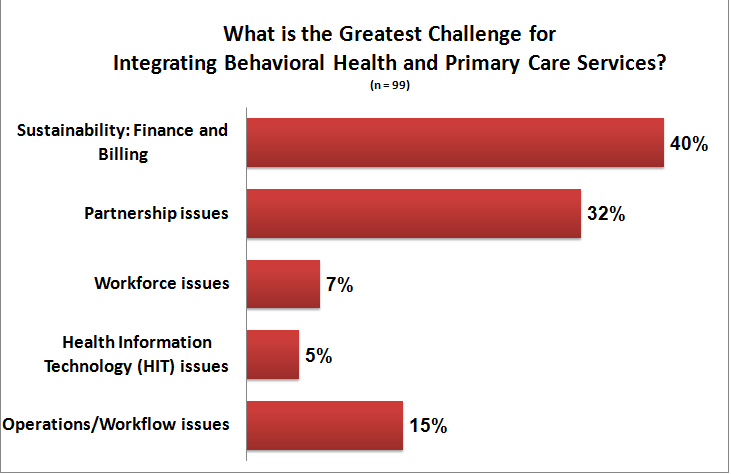
Poll results from LinkedIn group, Behavioral Health Integration 3/5/2012 – 3/5/2013
Finance and Billing
Poll responses indicated that sustainability issues related to finance and billing were the greatest challenge for integration efforts. While many providers have successfully overcome this barrier, it is no easy feat to develop a financially sustainable integrated services delivery system. Fortunately, the ACA created an optional Medicaid State Plan benefit for states to establish Health Homes to coordinate care for people with chronic conditions who receive Medicaid benefits. While only a handful signed on initially, there are currently 24 states and the District of Columbia who have elected to participate in the Medicaid Expansion. Fourteen states have elected not to participate; and 12 states remain undecided. (Click here for more information on where each state stands on ACA’s Medicaid expansion.)
States that are moving forward with Medicaid Health Homes are in the process of making adjustments to policies, billing, and service delivery to enable service providers to integrate behavioral health and primary care services, a requirement of Health Homes:
Regular visitors to this blog know that much has been published here about the partnership between behavioral health and primary care providers. This was ranked as second most challenging in the poll.
Why do so many people find partnership issues as challenging? It’s counterintuitive. Most providers approach the integration of behavioral health and primary care with a blind eye to the process of partnership development. It is assumed that the interpersonal aspects will fall into place. Unfortunately, it is far more likely that an integration effort will fail due to partnership issues than financial ones. They are not unlike other partnerships, requiring attention to building a strong foundation from the onset.
All healthcare administrators acknowledge the importance of operations for successful service delivery. That’s why 15% of respondents to the poll indicated that this area is the greatest challenge. Once a smooth-running clinic takes on an entirely new service-line, a degree of disruption is inevitable. The workflow will likely be drastically different than the service providers and support staff have grown accustomed to. Of course, taking on a new service also means addressing the organization’s policies, regulatory requirements, physical space requirements, etc.
With a little careful planning and a LOT of patience, your new integrated clinic will be operating smoothly in no time. Click here for a useful integration planning checklist.
Workforce Issues
Seven percent of the respondents indicated that workforce is the greatest challenge. With the current shortage of primary care providers, nurses, and psychiatrists, it’s no wonder that this is of concern. Fortunately, programs for training about integrated care delivery are available, such as the University of Massachusetts Medical School’s Center for Integrated Primary Care, which offers three programs aimed at training healthcare providers for providing integrated services:
Despite concerns over the dilemma of sharing health records for integrating behavioral health and primary care, health information technology garnered 5% of the responses. Fortunately vendors of electronic health records are working earnestly to develop products that allow for the seamless sharing of behavioral health and primary care records. (Click here for more information on the role of HIT in integrated healthcare.)
One Year Later
What are the greatest challenges to integrating behavioral health and primary care in 2013? What will be the challenges next year? Dare we suggest that in the near future there will no longer be challenges?
Behavioral health advocacy groups are expressing concern over recent media attention about people who may or may not be suffering from mental illness.
And they should be.
The horrendous acts committed in the recent past in Connecticut, Oregon, Colorado, etc. are tragic acts of violence. However, make no mistake that these atrocities are NOT synonymous with mental illness.
The fear of advocacy groups, such as the National Alliance on Mental Illness, A New PATH, and Mental Health America, is that the association between behavioral health and these violent acts will result in increased stigma. These and other groups have worked diligently for many years to reduce/eliminate the negative stereotypes associated with mental illness and substance use disorders.
However, the grain of truth to be derived is that behavioral health services need to be more accessible. Ongoing cuts to behavioral health budgets by states over the past few years have resulted in inadequate coverage (click here for NAMI’s chart: State Mental Health Budgets FY2009-FY2012).
Community Behavioral Health Safety Net
Community behavioral health providers are mandated to serve more people with funding that is steadily decreasing and with no hope in sight. The safety net is nearly frayed beyond repair.
Health Reform has spawned a wide array of innovative approaches to healthcare delivery. The integration of behavioral health and primary care is one such alternative that holds great promise for mental health and substance use services.
When primary care providers integrate behavioral health services, there is a dramatic increase in access to services. When behavioral health is included in routine screenings, the stigma of seeking behavioral health services is removed and opportunity for early detection is dramatically increased. Depression, anxiety, and substance use screenings are normalized through inclusion with height, weight, and blood pressure.
Research shows that depression impacts such chronic health conditions as heart disease. Concurrent treatment of behavioral health and physical health conditions results in improved health outcomes. In addition, integrated behavioral health and primary care services results in reduced healthcare costs.
Integrating behavioral health and primary care is a win-win for patients and providers.
Healthcare providers across the US and in many other countries are integrating services in order to improve service delivery. As individuals, we can do our part by reporting both behavioral health and physical health symptoms to our healthcare providers. Remember, healthcare is a partnership. You are a vital member of your healthcare team.
Cardiometabolic syndrome (diabetes, hypertension, obesity, and dyslipidemia) is prevalent among people living with serious behavioral health conditions resulting in their dying decades prematurely. The integration of behavioral health and primary care holds great promise for improving health outcomes. Not only are comorbid conditions treated concurrently, the focus on wellness/prevention allows for learning healthy habits.
Focus on Wellness
The following video, Be One in a Million, was created by Intecovery Cobb CSB and the Peer Support Program at Cobb/Douglas CSB as part of the Million Hearts initiative. It provides a look at the prevalence of preventable health conditions and the contributing factors. This inspiring video features individuals who self-identify as living with behavioral health disorders and thought-leaders in healthcare integration. It provides suggestions of ways to adopt a healthier lifestyle.
Enjoy…after watching you may decide to take the pledge, too!
The integration of behavioral health and primary care services allows for a holistic approach for the treatment of people with serious behavioral health disorders. As the disparate healthcare providers join together to provide treatment, the obvious differences between them must be addressed for success.
There are misconceptions that behavioral health providers want to address with their primary care partners for maximizing their integration efforts.
Understanding the Community Behavioral Health Core Mission
Community Behavioral Health Centers (CBHCs) are specialty behavioral healthcare providers and serve a vital role in the healthcare industry. The community behavioral health system provides treatment for individuals who have serious mental illnesses, substance use disorders, co-occurring SMI/SUD, and children and adolescents with serious emotional disturbances. These organizations are not a repository for the worried well. Their role is to address complex disorders that are generally beyond the scope of practice of primary care providers. In addition to providing psychiatric oversight, they also possess an expertise in rehabilitation and recovery that is not available in primary care. These services include psychosocial rehabilitation, peer support, case management, supported employment, and supportive housing. Treatment is provided through a team approach that begins with a thorough biopsychosocial assessment to identify life stressors, level of functioning, and clinical symptomology. Services are directed by the psychiatrist or psychiatric-extender who serves as prescriber. Counseling, rehabilitation, recovery, and support services are carried out by other members of the team. CBHCs can work collaboratively with CHCs to effectively meet the whole health needs of people with behavioral health concerns.
Differing Pace and Workflow
The CBHC pace is very unlike that of the primary care clinic. Long waits for appointments are the norm rather than the exception. CBHC office visits with the prescriber frequently exceed the standard 15 minute allotment in the CHC. This is due to the complexity of symptoms of many of the individuals served. While some CBHCs are beginning to use an open access approach, most are still using the standard scheduled appointment model that may result in a several week wait to see a prescriber. This has been a barrier to working collaboratively in the past. CHCs have opted to avoid making referrals because of the excessive wait and lack of status updates.
A side note: behavioral health can assist with the flow in the primary care setting. The flow of busy primary care clinics can be side-railed by patients with behavioral health disorders in addition to their other health concerns. Adding a behavioral health specialist to the team to address the behavioral health issues improves the flow, patient satisfaction, and clinical outcomes.
Lack of Regulation Uniformity
Reimbursement for CBHC services varies greatly from primary care. Block grants for mental health and substance use disorder treatment are regulated at the state level, resulting in a lack of consistency. Each state has created its own system for determining how the funds are allocated and how outcomes are measured. The process of billing for and receiving reimbursement for services is tedious. Some states have opted for capitation; others have a fee for service system. Other states have outsourced this to managed care companies. Historically private insurance has not provided equitable coverage for behavioral health disorders, creating a gap between coverage for behavioral health and physical health conditions. A mental health law, the Paul Wellstone and Pete Domenici Mental Health Parity and Addiction Equity Act, ensures that individuals with mental health and substance use disorders receive healthcare services equal to those for physical health conditions without larger co-pays.
Specialty behavioral health services for individuals who have a serious mental illness and one or more comorbid health condition requires coordinated care. Ideally the care is delivered via the behavioral health home. The team is led by the psychiatrist working closely with the entire treatment team, including the primary care provider.
Stigma is a barrier to accessing services for people with behavioral health disorders. Historically preconceived notions associated with behavioral health disorders have limited effective access to healthcare by many individuals.
Due to the pervasive lack of support systems for people with serious behavioral health conditions, the role of case manager is extremely important for supporting identified functional needs. Case managers frequently assist clients with preparing for visits with their primary care provider and often accompany them as well to ensure coordinated care.
Solution for Information Sharing
Historically CBHCs have not freely communicated with primary care about their shared patients. This originated because of a common misperception that has persisted in behavioral health that sharing mental health and substance use information with primary care providers is prohibited without going through an elaborate process. CBHCs realize that this has created a barrier for collaboration and are actively working at developing a solution; addressing HIPAA/confidentiality and 42 CFR Part 2 to develop a process for effectively sharing information.
It is through increased understanding of the differences between the healthcare partners that true success will occur, evidenced by improved health outcomes.
HIT is critical to the success of health homes and healthcare integration, allowing behavioral health and primary care providers to share information. This sharing enables healthcare providers to have access to all available healthcare information related to the individual being served. And this, of course, results in improved health outcomes. The SAMHSA-HRSA Center for Integrated Health Solutions has a wide array of HIT resources: click here for more information.
The Past
Not too many years ago, healthcare providers were handwriting or dictating their progress notes. When patients were seen outside the office, or if the notes were not yet filed in the chart, the limited amount of information available created a challenge to providing the best care. A patient who was unable to provide a thorough medical history was being treated blindly in some regards. And health implications aside, numerous medical procedures were repeated due to lack of access to the reports. Duplication of the procedures drove up healthcare costs.
In addition, the sharing of information between providers was the exception rather than the rule. Coordination of care between providers for patients referred to specialty care was not reimbursed and, as a result of limited resources, less than ideal. This brief history lesson on medical records serves to illustrate the value of electronic health records and health information technology.
Fast Forward to the Present
Though far from ideal, the healthcare industry is making great strides in health information technology, including health information exchanges (HIEs) designed to facilitate the sharing of data. Despite the rapid progress, sharing information continues to be a challenge for behavioral health and primary care organizations. These integration efforts create unique challenges, largely due to problems with sharing information between two systems. The electronic health records (EHRs) used by primary care providers are seldom compatible with EHRs used by behavioral health providers. While some partnerships have implemented means of addressing this (work arounds), such as a third system to link the two or “home grown” alternatives, there are currently no ideal options available.
These noble community providers persevere however. They are well accustomed to dealing with challenges in the quest for pursuing their mission. People with serious mental illness are dying prematurely; and has been inadvertently perpetuated by this lack of information sharing. In an attempt to be respectful and responsible with healthcare information, limitations (and misunderstandings) have impeded information sharing. The Health Insurance Portability and Accountability Act of 1996 (HIPAA), Public Law 104-191 and Title 42: Public Health Part 2—Confidentiality of Alcohol and Drug Abuse Patient Records, also known as 42-CFR Part 2, are the most frequently cited reasons for not sharing information. These federal regulations cite guidelines for confidential health information. Though intended to provide clarity, healthcare organizations have interpreted the regulations very conservatively.
The Future
HIT has changed the face of healthcare and holds great promise for the future of behavioral health and primary care integration. Health information technology is not only providing cost-effective means of providing superior collaborative treatment, it is paving the way for reducing the health disparities for people with serious mental illness and other behavioral health conditions.
For the past few years, community behavioral health and primary care organizations have been working collaboratively to provide services for the people they serve, diligently trying to create the perfect formula for doing what is best for the healthcare needs of the people they serve, while at the same time striving to remain financially solvent. And they have done a remarkable job! But it isn’t easy…nor have their outcomes always been ideal, largely due to limited resources. Certainly not for lack of trying!
These benevolent community providers are charged with serving the most in need. This does not always translate into being adequately compensated for their efforts, however. While some have been forced to limit their services, most have managed to avoid rationing thus far through their persistence in seeking alternatives, such as creating referral agreements, co-locating, full integration, and with grant funding. In addition, many have engaged in advocating for change at the local, state, and national levels. These tenacious providers recognize that an unwavering focus on the mission is the foundation for success.
With the newly upheld Affordable Care Act, more people will have access to healthcare coverage and will not be rejected because of pre-existing conditions. Also, for the states that don’t opt out of the new Medicaid expansion, all residents below the 133 percent of the poverty line will be eligible for Medicaid coverage. Therefore, more of the people served by community providers who were previously uninsured will have healthcare coverage. This will allow the providers to be compensated for more of the services they provide, thus supporting the mission.
The ACA doesn’t provide all the answers but it is a move in the right direction. Politics aside, our healthcare system isn’t working the way it is. We need major changes. We already know that integrating behavioral health and primary care services is more economical and provides improved health outcomes. Through these health homes, individual care is coordinated. That just makes sense. The health home approach translates into better care for fewer healthcare dollars. This is a perfect opportunity to build on a successful model.
With our newly upheld Accountable Care Act at the cusp of our nation’s 236th birthday, it’s a perfect time to pull together and focus on building a system that allows us to provide effective services to meet the total healthcare needs of people with behavioral health concerns in this, the land of the free and the home of the (soon t0 be) healthy.
A company’s greatest asset is its workforce. The employees are the lifeblood of organizations, as I’m sure most leaders would agree. Therefore, paying close attention to keeping your employees informed and engaged when entering into an integrated behavioral health and primary care partnership is crucial for success. And the sooner, the better.
Sibling Rivalry
Like blended families, the integration of two organizations brings up some fundamental concerns among the employees. Concerns over job security, roles, and change in general are paramount. Your employees will be working with the employees from the partner company and will not likely develop into a cohesive team immediately. Additional challenges are introduced with the unique role of the employees who are hired jointly by the partners. The uncertainty and anxiety are sure to result in sibling rivalry among employees. Sibling rivalry is characterized by a jealousy that develops between employees, much the same as it does among siblings. This, of course, impedes teamwork, especially if some members of the team are granted a superior status. This sometimes happens when the integration efforts are held out as being a special or top-priority project. While it’s not possible to eliminate all anxiety, it’s possible to avoid sibling rivalry among your, my, and our employees and to allow them to transition into a unified team.
Healthcare integration is in its infancy and trained workforce is sparse. However, it is not necessary to hire new employees for your enhanced services. Providing training for employees, ongoing thorough and consistent communication, coupled with reassurance on the front end will go a long way toward successful integration of the employees, and are key to success. The following guidelines will help to promote a close-knit and committed integrated team:
Communicate an overview of the vision of the partnership followed with frequent status updates. This also helps your team develop a sense of buy-in to the mission.
Provide each team member with a clear understanding of his or her role and how it fits into the whole.
Provide ample training for all team members to ensure that they are well prepared for healthcare integration.
Building trust among employees is vital for effective teamwork. Frequent opportunities for face-to-face interaction are important for developing a sense of camaraderie.
Champions within the organization play a large role in the success of projects. Recognize them (they are in all levels of the organization, just look for them) and allow them to take on leadership roles.
As with all new endeavors, solicit feedback from your team. By providing an environment that values candor, early missteps are quickly corrected and creative ideas are put to use for long-term success.
It’s important to recognize that some people belong on the bus but are just in the wrong seats. Keep an eye out for employees who are on board with the mission but struggling with their current role(s). These employees are keepers and should be placed in roles that emphasize their strengths.
And vital to a successful team, it’s important to acknowledge when an employee is neither prepared nor motivated for the adjustment in the mission and must seek professional fulfillment elsewhere.
What would you add to this list?
For successful healthcare integration, focused attention to your workforce can quickly transition “yours, mine, and ours” to an effective integrated team.








 tegration of behavioral health and primary care services allows for a holistic approach for the treatment of people with serious behavioral health disorders. As the disparate healthcare providers join together to provide treatment, the obvious differences between them must be addressed for success.
 Behavioral Health Integration