In 2008, Congress passed the Paul Wellstone and Pete Domenici Mental Health Parity and Addiction Equity Act, marking an important step forward in efforts to end discrimination in insurance coverage for mental health and substance use disorder treatment. While the act closed several loopholes left by the 1996 Mental Health Parity Act, it has taken five years to finalize the law. The 2008 act lacked clarity on how parity is to be achieved, particularly when treatment involves intensive care at physician offices or long-term hospital stays.
Today’s ruling provides clarification on how parity applies to residential treatments and outpatient care. It also ensures that copayments, deductibles, and limits on mental health benefits are not more restrictive or provide less coverage than those for medical and surgical benefits, including geographic or facility limitations. These have been tremendous barriers to treatment thus far and represent a significant triumph for the behavioral health community.
“This is the largest expansion of behavioral health coverage in a generation,” declared Secretary Sebelius. Addressing the need for adequate care for mental health has been a goal for more than 50 years, when President John F. Kennedy signed the Community Mental Health Center Act of 1963 into law.
At long last, treatment for behavioral health disorders is regarded as equal to other types of healthcare. This represents a significant achievement in behavioral health and should contribute to the ongoing effort to reduce the stigma. Millions fail to follow up with needed treatment because of stigma. With this final ruling and with movement toward integrated care, we will finally be able to improve access.
What will the world be like when people begin to actually receive that needed treatment?
Today marks the 50th anniversary of the date that President John F. Kennedy signed the 1963 Community Mental Health Act into law. It was to be the last before his death on 11/22/63. The Act represents a monumental turning point in the treatment of psychiatric disorders. President Kennedy’s call to action in 1963 was based on a belief that all Americans – including those with mental illnesses, intellectual disabilities, and addictions – have a right to lead dignified lives and to share in the benefits of our society. Patrick Kennedy, nephew of President Kennedy and former U.S. Representative of Rhode Island, is steadfast in his efforts to continue this important work via the Kennedy Forum.
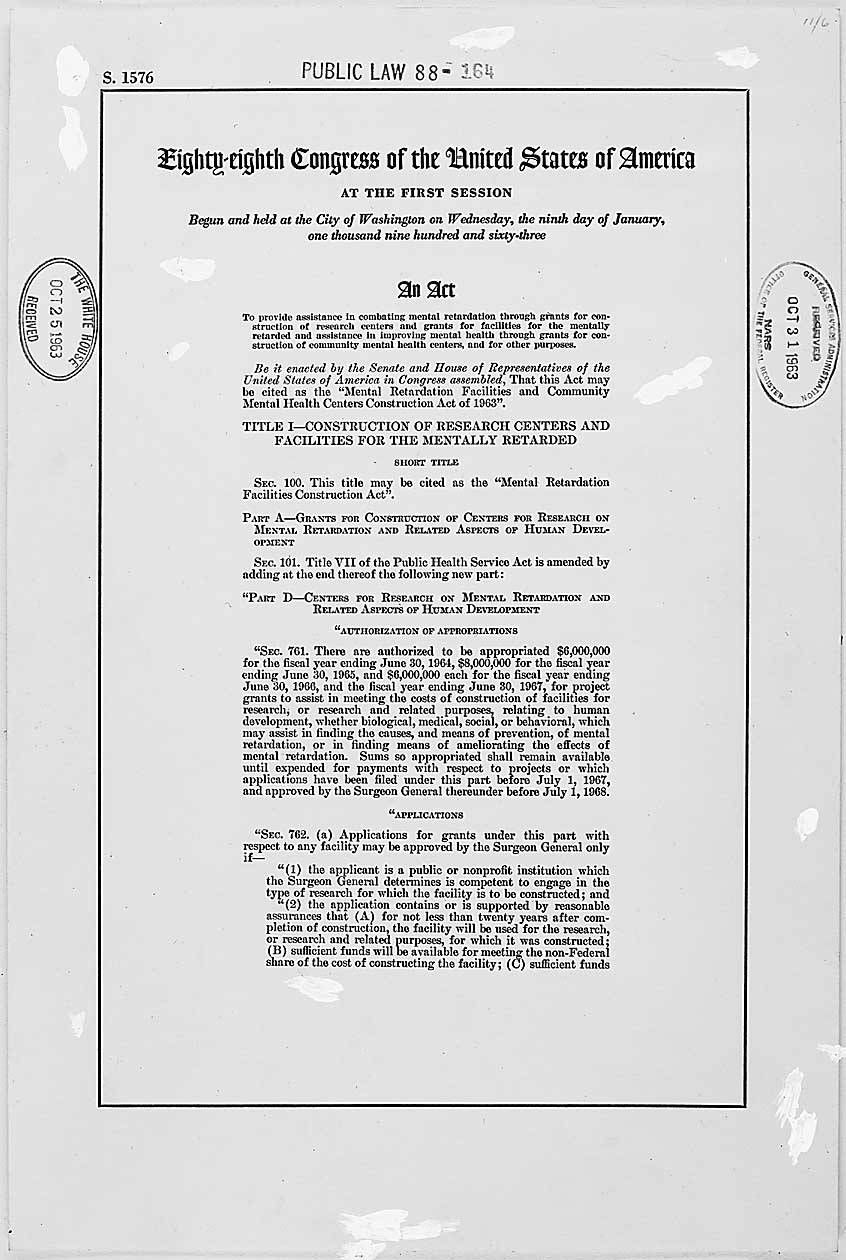
Act of October 31, 1963 “Mental Retardation Facilities and Community Mental Health Centers Construction Act of 1963”, Public Law 88-164, 77 STAT 282, “to provide assistance in combating mental retardation through grants for construction of research centers and grants for facilities for the mentally retarded and assistance in improving mental health through grants for construction of community mental health centers, and for other purposes.”, 10/31/1963 (Figure 1 below)
History of Psychiatric Treatment
Figure 1: Mental Retardation and Community Mental Health Centers Construction Act of 1963
Early attempts to treat mental illness are thought to date back to 5000 B.C. or earlier, based on the discovery of trephine skulls. A series of barbaric practices followed for millennia. It is suspected that the first asylums were established around the sixteenth century. These early facilities offered no real treatment despite their primitive attempts at cures, consisting of the use of leeches, purges, barbaric contraptions, and the use of chains and other restraints. Conditions gradually began to improve by the mid 1800s thanks to efforts led by humanitarians such as Dorothea Dix. Treatment reform in the asylums offered a more humane approach to the care of people with mental illness.
New treatment options followed in the early twentieth century, including psychoanalysis, introduced by Austrian neurologist, Sigmund Freud, and electroconvulsive therapy, introduced by Italian neuropsychiatrists, Ugo Cerletti and Lucio Bini. Psychopharmacology followed, arguably providing the single most significant change in treatment to date. A former colleague, psychiatrist, Dr. John Wolaver, remarked that when Thorazine was introduced in the psychiatric hospitals, the facilities were suddenly calm and quiet for the first time. It seemed to be a miracle cure. Psychopharmacology provided the next necessary step that led to deinstitutionalization.
The introduction of the Mental Retardation and Community Mental Health Centers Construction Act of 1963, Public Law 88-164, a bold new effort, forever changed the face of mental health treatment. Prior to this, it was not uncommon for individuals with behavioral health conditions to be hospitalized for many years; hundreds of thousands lived their lives in institutions and were buried on the grounds. Unfortunately, this deinstitutionalization effort fell short of its goal. The USA Today report, Kennedy’s Vision for Mental Health Never Realized, takes a candid look at this.
Figure 2 below illustrates the decrease in inpatient treatment between 1950 and 1995. As the psychiatric hospitals decreased in size, the homeless population grew. The jails and prisons began to fill with the individuals with behavioral health conditions. According to the 10/24/13 article, Why Are The Three Largest Mental Health Care Providers Jails? published by NewsOne: The three largest mental health providers in the nation are the following jails: Cook County in Illinois, Los Angeles County and Rikers Island in New York.
Figure 2: Deinstitutionalization
Integrated Care
Many thought-leaders believe that we have embarked upon another pivotal point in mental health (or more broadly, behavioral health) treatment. Mental Health: A Report of the Surgeon General published in 1999 called for the integration of behavioral health and primary care. And the 2006 NASMHPD report, Morbidity and Mortality in People with Serious Mental Illness has prompted the movement toward a whole health approach to treatment that integrates behavioral health and primary healthcare. This promising trend offers hope for improved access for individuals who live with mental health and/or substance use disorders, improved health outcomes, and controlling healthcare spending.
Let us work together to address health conditions wherever the individual presents for treatment. Healthcare must be redefined to include behavioral health. By removing the healthcare silos, providers will begin to recognize and treat the comorbid conditions in their patients. Mind-body integration improves patient outcomes and reduces costs.
Integrated care is necessary for improving the lives of of those who might have spent his or her life chained in a dungeon centuries ago. It is a key element in our efforts to achieve the Triple Aim.
This is Mental Illness Awareness Week and today has been designated as both World Mental Health Day and National Depression Screening Day. Social media has numerous posts this week promoting mental health awareness and related topics as we try to educate the general public. We strive for increased awareness of the importance of good mental health as well as the challenges related to the stigma surrounding mental illness.
Integrating mental health and substance use disorder treatment with primary healthcare provides the opportunity to both increase awareness and decrease the stigma associated with behavioral health issues. Integrated care helps to improve access, reduce costs, and improve outcomes. Integrated care is better care!
In 1990, the U.S. Congress established the first full week of October as Mental Illness Awareness Week (MIAW) in recognition of the National Alliance on Mental Illness’s (NAMI) efforts to raise mental illness awareness. Since then, mental health advocates across the country have joined with others in their communities to sponsor activities, large or small, for public education about mental illness.
Today, 10/10/13, is designated as World Mental Health Day. This year’s theme is “Mental Health and Older Adults.” The day is celebrated at the initiative of the World Federation of Mental Health (WFMH) and the World Health Organization (WHO) supports this initiative through raising awareness on mental health issues using its strong relationships with the Ministries of Health and civil society organizations across the globe.
Today is also National Depression Screening Day. National Depression Screening Day raises awareness and screens people for depression and anxiety disorders. NDSD is the nation’s oldest voluntary, community-based screening program that gives access to a validated screening questionnaire and provides referral information for treatment. More than half a million people each year have been screened for depression since 1991.
Let us work together to promote good mental health locally and around the world.
The poll generated a tremendous amount of interest, both in voting on the poll and in comments. Much has happened in the healthcare industry in the past twelve months, changes that have an impact on the way behavioral health and primary care will be delivered in the future.
The greatest impact has come from the Patient Protection and Affordable Care Act (ACA) that was upheld by the Supreme Court of the United States on June 28, 2012. Though passed in 2010, the flurry of activity toward implementing began after the Supreme Court ruling. As states prepare for the 2014 implementation of the new health laws, more and more are agreeing to participation in the Medicaid Health Home plan.
Poll Results
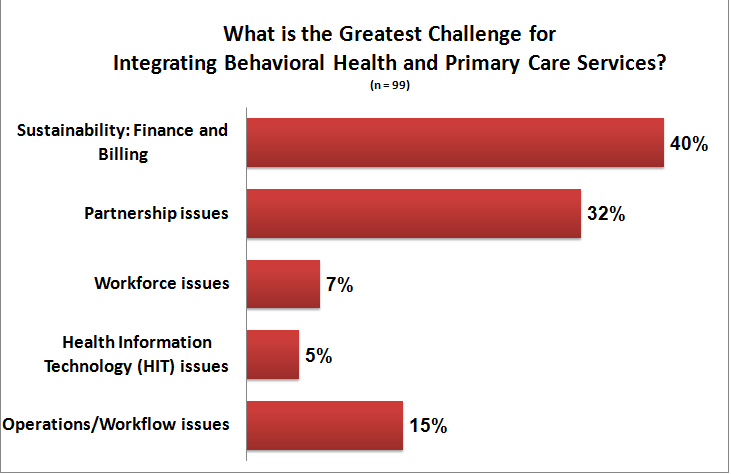
As we near the end of the first quarter 2013, time is running out quickly for implementation. With integrated care playing a crucial role in health reform, the challenges for integrating healthcare services are more and more apparent. Revisiting the below results of the poll conducted one year ago, one has to wonder whether the perceived challenges remain the same among healthcare providers.
Poll results from LinkedIn group, Behavioral Health Integration 3/5/2012 – 3/5/2013
Finance and Billing
Poll responses indicated that sustainability issues related to finance and billing were the greatest challenge for integration efforts. While many providers have successfully overcome this barrier, it is no easy feat to develop a financially sustainable integrated services delivery system. Fortunately, the ACA created an optional Medicaid State Plan benefit for states to establish Health Homes to coordinate care for people with chronic conditions who receive Medicaid benefits. While only a handful signed on initially, there are currently 24 states and the District of Columbia who have elected to participate in the Medicaid Expansion. Fourteen states have elected not to participate; and 12 states remain undecided. (Click here for more information on where each state stands on ACA’s Medicaid expansion.)
States that are moving forward with Medicaid Health Homes are in the process of making adjustments to policies, billing, and service delivery to enable service providers to integrate behavioral health and primary care services, a requirement of Health Homes:
Regular visitors to this blog know that much has been published here about the partnership between behavioral health and primary care providers. This was ranked as second most challenging in the poll.
Why do so many people find partnership issues as challenging? It’s counterintuitive. Most providers approach the integration of behavioral health and primary care with a blind eye to the process of partnership development. It is assumed that the interpersonal aspects will fall into place. Unfortunately, it is far more likely that an integration effort will fail due to partnership issues than financial ones. They are not unlike other partnerships, requiring attention to building a strong foundation from the onset.
All healthcare administrators acknowledge the importance of operations for successful service delivery. That’s why 15% of respondents to the poll indicated that this area is the greatest challenge. Once a smooth-running clinic takes on an entirely new service-line, a degree of disruption is inevitable. The workflow will likely be drastically different than the service providers and support staff have grown accustomed to. Of course, taking on a new service also means addressing the organization’s policies, regulatory requirements, physical space requirements, etc.
With a little careful planning and a LOT of patience, your new integrated clinic will be operating smoothly in no time. Click here for a useful integration planning checklist.
Workforce Issues
Seven percent of the respondents indicated that workforce is the greatest challenge. With the current shortage of primary care providers, nurses, and psychiatrists, it’s no wonder that this is of concern. Fortunately, programs for training about integrated care delivery are available, such as the University of Massachusetts Medical School’s Center for Integrated Primary Care, which offers three programs aimed at training healthcare providers for providing integrated services:
Despite concerns over the dilemma of sharing health records for integrating behavioral health and primary care, health information technology garnered 5% of the responses. Fortunately vendors of electronic health records are working earnestly to develop products that allow for the seamless sharing of behavioral health and primary care records. (Click here for more information on the role of HIT in integrated healthcare.)
One Year Later
What are the greatest challenges to integrating behavioral health and primary care in 2013? What will be the challenges next year? Dare we suggest that in the near future there will no longer be challenges?
Cardiometabolic syndrome (diabetes, hypertension, obesity, and dyslipidemia) is prevalent among people living with serious behavioral health conditions resulting in their dying decades prematurely. The integration of behavioral health and primary care holds great promise for improving health outcomes. Not only are comorbid conditions treated concurrently, the focus on wellness/prevention allows for learning healthy habits.
Focus on Wellness
The following video, Be One in a Million, was created by Intecovery Cobb CSB and the Peer Support Program at Cobb/Douglas CSB as part of the Million Hearts initiative. It provides a look at the prevalence of preventable health conditions and the contributing factors. This inspiring video features individuals who self-identify as living with behavioral health disorders and thought-leaders in healthcare integration. It provides suggestions of ways to adopt a healthier lifestyle.
Enjoy…after watching you may decide to take the pledge, too!
The integration of behavioral health and primary care services allows for a holistic approach for the treatment of people with serious behavioral health disorders. As the disparate healthcare providers join together to provide treatment, the obvious differences between them must be addressed for success.
There are misconceptions that behavioral health providers want to address with their primary care partners for maximizing their integration efforts.
Understanding the Community Behavioral Health Core Mission
Community Behavioral Health Centers (CBHCs) are specialty behavioral healthcare providers and serve a vital role in the healthcare industry. The community behavioral health system provides treatment for individuals who have serious mental illnesses, substance use disorders, co-occurring SMI/SUD, and children and adolescents with serious emotional disturbances. These organizations are not a repository for the worried well. Their role is to address complex disorders that are generally beyond the scope of practice of primary care providers. In addition to providing psychiatric oversight, they also possess an expertise in rehabilitation and recovery that is not available in primary care. These services include psychosocial rehabilitation, peer support, case management, supported employment, and supportive housing. Treatment is provided through a team approach that begins with a thorough biopsychosocial assessment to identify life stressors, level of functioning, and clinical symptomology. Services are directed by the psychiatrist or psychiatric-extender who serves as prescriber. Counseling, rehabilitation, recovery, and support services are carried out by other members of the team. CBHCs can work collaboratively with CHCs to effectively meet the whole health needs of people with behavioral health concerns.
Differing Pace and Workflow
The CBHC pace is very unlike that of the primary care clinic. Long waits for appointments are the norm rather than the exception. CBHC office visits with the prescriber frequently exceed the standard 15 minute allotment in the CHC. This is due to the complexity of symptoms of many of the individuals served. While some CBHCs are beginning to use an open access approach, most are still using the standard scheduled appointment model that may result in a several week wait to see a prescriber. This has been a barrier to working collaboratively in the past. CHCs have opted to avoid making referrals because of the excessive wait and lack of status updates.
A side note: behavioral health can assist with the flow in the primary care setting. The flow of busy primary care clinics can be side-railed by patients with behavioral health disorders in addition to their other health concerns. Adding a behavioral health specialist to the team to address the behavioral health issues improves the flow, patient satisfaction, and clinical outcomes.
Lack of Regulation Uniformity
Reimbursement for CBHC services varies greatly from primary care. Block grants for mental health and substance use disorder treatment are regulated at the state level, resulting in a lack of consistency. Each state has created its own system for determining how the funds are allocated and how outcomes are measured. The process of billing for and receiving reimbursement for services is tedious. Some states have opted for capitation; others have a fee for service system. Other states have outsourced this to managed care companies. Historically private insurance has not provided equitable coverage for behavioral health disorders, creating a gap between coverage for behavioral health and physical health conditions. A mental health law, the Paul Wellstone and Pete Domenici Mental Health Parity and Addiction Equity Act, ensures that individuals with mental health and substance use disorders receive healthcare services equal to those for physical health conditions without larger co-pays.
Specialty behavioral health services for individuals who have a serious mental illness and one or more comorbid health condition requires coordinated care. Ideally the care is delivered via the behavioral health home. The team is led by the psychiatrist working closely with the entire treatment team, including the primary care provider.
Stigma is a barrier to accessing services for people with behavioral health disorders. Historically preconceived notions associated with behavioral health disorders have limited effective access to healthcare by many individuals.
Due to the pervasive lack of support systems for people with serious behavioral health conditions, the role of case manager is extremely important for supporting identified functional needs. Case managers frequently assist clients with preparing for visits with their primary care provider and often accompany them as well to ensure coordinated care.
Solution for Information Sharing
Historically CBHCs have not freely communicated with primary care about their shared patients. This originated because of a common misperception that has persisted in behavioral health that sharing mental health and substance use information with primary care providers is prohibited without going through an elaborate process. CBHCs realize that this has created a barrier for collaboration and are actively working at developing a solution; addressing HIPAA/confidentiality and 42 CFR Part 2 to develop a process for effectively sharing information.
It is through increased understanding of the differences between the healthcare partners that true success will occur, evidenced by improved health outcomes.
HIT is critical to the success of health homes and healthcare integration, allowing behavioral health and primary care providers to share information. This sharing enables healthcare providers to have access to all available healthcare information related to the individual being served. And this, of course, results in improved health outcomes. The SAMHSA-HRSA Center for Integrated Health Solutions has a wide array of HIT resources: click here for more information.
The Past
Not too many years ago, healthcare providers were handwriting or dictating their progress notes. When patients were seen outside the office, or if the notes were not yet filed in the chart, the limited amount of information available created a challenge to providing the best care. A patient who was unable to provide a thorough medical history was being treated blindly in some regards. And health implications aside, numerous medical procedures were repeated due to lack of access to the reports. Duplication of the procedures drove up healthcare costs.
In addition, the sharing of information between providers was the exception rather than the rule. Coordination of care between providers for patients referred to specialty care was not reimbursed and, as a result of limited resources, less than ideal. This brief history lesson on medical records serves to illustrate the value of electronic health records and health information technology.
Fast Forward to the Present
Though far from ideal, the healthcare industry is making great strides in health information technology, including health information exchanges (HIEs) designed to facilitate the sharing of data. Despite the rapid progress, sharing information continues to be a challenge for behavioral health and primary care organizations. These integration efforts create unique challenges, largely due to problems with sharing information between two systems. The electronic health records (EHRs) used by primary care providers are seldom compatible with EHRs used by behavioral health providers. While some partnerships have implemented means of addressing this (work arounds), such as a third system to link the two or “home grown” alternatives, there are currently no ideal options available.
These noble community providers persevere however. They are well accustomed to dealing with challenges in the quest for pursuing their mission. People with serious mental illness are dying prematurely; and has been inadvertently perpetuated by this lack of information sharing. In an attempt to be respectful and responsible with healthcare information, limitations (and misunderstandings) have impeded information sharing. The Health Insurance Portability and Accountability Act of 1996 (HIPAA), Public Law 104-191 and Title 42: Public Health Part 2—Confidentiality of Alcohol and Drug Abuse Patient Records, also known as 42-CFR Part 2, are the most frequently cited reasons for not sharing information. These federal regulations cite guidelines for confidential health information. Though intended to provide clarity, healthcare organizations have interpreted the regulations very conservatively.
The Future
HIT has changed the face of healthcare and holds great promise for the future of behavioral health and primary care integration. Health information technology is not only providing cost-effective means of providing superior collaborative treatment, it is paving the way for reducing the health disparities for people with serious mental illness and other behavioral health conditions.
The early days of the integrated healthcare relationship are typically idyllic, filled with smiles and hopes and dreams. Oh, if we could only maintain that blissful state forever…
Unfortunately relationships don’t maintain a static pattern but are interspersed with disruptions on occasion (or frequently). When these disturbances intervene, the blissful state is challenged.
These are the times that try administrators’ souls.
For a partnership to persevere the inevitable challenges, the basic foundation must be solid. Just as skyscrapers are built with deep foundations that are not only solid but allow flexibility to prevent collapse when severe environmental or other hazardous conditions erupt, the integrated partnership requires a carefully developed, yet flexible foundation. With a firm core, the relationship has the elements in place to withstand challenges that are sure to occur. (Click here for more information on building a successful behavioral health – primary care partnership.)
Sustainability Planning
Sustainability plans are often synonymous with financial sustainability but will occasionally focus on health information technology in the planning as well. The partnership itself, however, is often overlooked in the sustainability plan. This is unfortunate because if the partnership fails, the plan is rendered moot. The actual partnership itself is taken for granted after the initial honeymoon phase. This is a grave mistake for true sustainability.
Consider this scenario: Due to internal operational and fiscal needs, the behavioral health partner’s executive team has decided to reassign the integrated BH counselor who has been working in the primary care clinic for two years. The counselor will be replaced with another counselor who is more experienced and is credentialed in both mental health and substance use disorders. Seeing this rearrangement as a win-win, the behavioral health partner is shocked and confused when they hear that the primary care partner, in reaction to this news, is considering hiring their own counselor instead of accepting the replacement counselor. There are even rumors that they might pull out of the partnership.
What went wrong?
The behavioral health partner failed to include the primary care partner in the discussion, thus failing to honor the relationship; the primary care partner felt disrespected.
Rather than express concern to the behavioral health partner, the primary care partner took a reactionary approach instead.
Unaware of behavioral health partner’s internal issues, the primary care partner assumed the worst.
The behavioral health partner failed to understand the value of the individual to the team, not just for the service provided. Counselors are not interchangeable. The counselor was viewed as a valued member of the primary care team.
The executive teams of the partners stopped communicating after the partnership was launched, resulting in a weakening of the committment by each partner.
The list could go on.
This partnership, though financially sound, has neglected to nurture the core relationship. As long as things were going smoothly, the partnership appeared to be successful. Unfortunately, a slight disruption to the routine has threatened the weak core of the partnership. In addition to the obvious lack of effective communication taking place in this dysfunctional relationship, there are other factors also present that are all too common in partnerships:
Lack of commitment
Lack of respect
Commitment and respect underscore the core requirements for longevity.
Commitment
All partners must be committed to ensuring that integration efforts have the necessary tools for success. This includes the committment of time, not just financial and other resources. When the commitment is present, there is no concern over “fair weather friends” syndrome.
Are you prepared to make sacrifices necessary for success?
When the going gets tough are you still committed?
Respect
Basic respect is crucial. Your partner has many challenges and concerns that are unrelated to your partnership. Respecting that these are important to your partner whether or not you can fully recognize the impact goes a long way toward being a good partner. Taking the time to gain a better understanding is even better.
Do you have a thorough understanding of your partner’s business model?
Do you understand the challenges that your partner faces specific to the specialty such as regulatory, operational, clinical, etc.?
Why are these things important?
Understanding and honoring the things that are important to your partner organization strengthens the core of your relationship. Remember, the Golden Rule applies to behavioral health and primary care integration partnerships, too.
Of the many challenges in integrating behavioral health and primary care services, the one that garners the most apprehension and concern is sustainability. It is also the most frequent reason for hesitation in moving forward. Healthcare is not set up to address this. Primary care and behavioral health have different billing codes with no easily decipherable means of venturing outside the confines to include payment for integrated services. The mere thought of the process required to begin to tear down the barriers separating the two worlds strikes fear in the hearts of the most courageous administrators.
Healthcare administrators are presented with conflicting demands and are struggling to reconcile the next step. They can:
Ignore the ever increasing focus on healthcare integration and hope it is just another passing fad; or
Place even more burden on the ever-shrinking budgets and hope for the best.
Let’s take a closer look at the options:
Ignoring healthcare integration seems like the easiest solution. Administrators can align themselves with like-minded peers creating a support group who reinforces the notion that it will all just fade away if they merely wait it out. This group gets considerable pleasure in observing the early adopters from a distance, filled with certainty that they are all making huge mistakes. They pat themselves on the back encouragingly as they watch their naïve peers make the occasional fumble, while attributing any successes to sheer (unsustainable) luck.
Over-burdening the current budget seems to be irresponsible. Behavioral health administrators have been faced with budget cuts in unprecedented amounts over the past few years. While they have either become masters at doing more with less or have chosen to leave the field entirely, taking on a new business-line during the increasing uncertainty of their organizations’ financial states seems to be overly risky and counterintuitive.
Yet the pressure is on.
Nationally, more and more behavioral health conferences are featuring healthcare integration tracks. The same is becoming true of primary care conferences and conventions as well. With more and more research and reports being released that provide the necessary data to support the need for integration, it’s becoming more and more difficult to write it off as a passing fad. The recent report from the SAMHSA-sponsored, National Survey on Drug Use and Health, Physical Health Conditions among Adults with Mental Illnesses provides further evidence supporting earlier reports demonstrating the need for integration.
The current model of providing behavioral healthcare may be on its way to becoming obsolete. Now is the time for behavioral healthcare administrators to begin the discussion of how to address the whole-health needs of the people they serve. Whether through collaborative partnership agreements, bi-directional integration, or full integration, this issue can no longer be ignored. There are many changes that can be implemented right away (focusing on billing codes and maximizing billing opportunities) while others will require advocating changes at the state and federal level. (Click here for helpful billing tools created by the SAMHSA-HRSA Center for Integrated Health Solutions.) Daunting though this may seem, the climate is right for these discussions with your state Medicaid and behavioral health offices. They are faced with the task of making the necessary changes to move into the new era of healthcare integration. Strategically, it’s far better to be a part of discussions on creating this new structure than to have it imposed on your organizations. The Georgia Association of Community Services Boards has partnered with the Carter Center to create a forum for change in Georgia via their Integrative Healthcare Learning Collaborative. Not only have they included the public behavioral health providers and their primary care partners, they also have representation from the Georgia Primary Care Association and area medical schools. They recognize that in order to develop sustainable programs everyone must be at the table.
What are your strategies for sustaining healthcare integration? I’d love to hear from you. Please enter your comments/suggestions/ideas below or email: behavioralhealthintegration@gmail.com.
Let’s not lose sight of the goal: we must work together to make a difference in improving health outcomes of the people we serve. We CAN ensure that the margin is there to continue the mission. Be a part of the solution!
The recent poll conducted via the LinkedIn group, Behavioral Health Integration, continued to generate thought-provoking comments following the last post. (Click here to see the initial results.) Thought-leaders, behavioral health, and primary care professionals have offered their perspectives on the pressing question:
Mark L: Community health records (CHR) that follows the patient and not the provider or payer source will create the sustainability –finance and billing that aid Partnerships to create better operations/workflow that in turn solve workforce issues.
I think the solution for integration of health care is an IT solution that allows for communication not in any “one” silo but in a cloud, it is the premise of the question about integration that it will be in a silo that leads to obsolescence or a least does not address systemic issues of communion about the actual needs of the patient first.
Providers at all levels of care need to exchange information both horizontally and vertically, such as a transfer of care to another provider at a higher or lower level of care. Also community integration of available resources for discharges from one provider to the next or transitions to the public systems from private system or vice versa.
The public and private sectors need to work together to “speak the same IT Language” the health record should follow the person in any system.
Acute care and mental health care systems need the same ability to communicate, whether or not you call the person a client or patient. Mental health and acute care providers can then communicate and bill on a “continuity of care” coordinating treatment for a patient as a team and not in silos.
The export of data from one CHR to the next is where standardization needs to be the focus. I am excited to see future of blending of Regional Health Information Organizations (RHIOs), Health Information Exchange (HIE). RHIOs and HIE are changing the discussion from silos to clouds.
Leslie B: This may be one of my favorite topics. Yes, I agree that IT can play a part of it, but that is not the only part of the system that needs to change. Like one of the members of discussion, the providers and their ability to talk to each other is one. Program Development requires system and staff changes, changes in thinking, and the ability to assess each site. Each Primary care setting has its own challenges, so one can say provider insight at one location and Behavioral Health provider readiness at another location and yet another location might have the inability to see each other’s records or there may be a staffing problem. I think the biggest challenge can be who is going to pay for it, once everybody in the system figures out what it is anyway. It may require more behavioral health providers and more medical providers. Will there really be a return on that investment. The patient would probably get more holistic care, but it isn’t going to cost any less money.
Bob H: I believe that one of the greatest challenges is that we need to stop talking about behavioral health and primary care and begin focusing on the needs of the individuals receiving our services and how our systems can best serve their needs. We need to include clear measures of ‘behavioral economics’ and understand that we all act and react to rewards and benefits. We need to structure our systems and our interventions to incentivize overall health improvements, whether behavioral or medical.
We will only have truely intregrated care when we are patient centered and stop distinguishing between behavioral health and primary care. That does not mean that we will not have specialists; whether they be psychiatric, medical, communication, design, or information and technology. It is all about the focus on the patient’s needs and building workflows to address those needs appropriately to assist them in reaching productive and effective outcomes as a result of our services and interventions.
Nelson B: In short, the greatest challenge of healthcare integration is getting paid for effective services. Coleman Professional Services will look at the best outcome of our customer; their health, their ability to have stable living conditions, volunteering or employed and their ability to appropriate socialize in their community. Let’s look at the outcome for our customer and get paid for this outcome.
Michael J: Reading this thread shows that there is a great deal of thought being put into this topic. I think that some of this boils down to a chicken and an egg. And Nelson is right on target about the pay systems. We in our industry have not truly integrated mental healthcare and addictions treatment. Now I know there are pockets of good co-occurring treatment programs here and there, but as an industry they continue to be separate. And the biggest reason is following the money. The money for these services are not braided, and so they stay separate.
I’m currently working on a perinatal mental health integration project. We know what to do clinically (we are using the IMPACT model) and we have OBs who want to participate. We have Medicaid insured women we have identified as needing care. But since the Medicaid is carved-out, the physical health Medicaid plan will not pay for the service as they don’t pay for MH services, and the MH plan won’t pay because they don’t purchase physician services from non-psychiatrists unless they are credentialed as a part of a licensed agency with a MH contract. If the insurance companies and the government wanted to have integrated healthcare, they would have it. If there was a requirement that integrated care was insisted upon for reimbursement we would be all over it. In fact, we do all sorts of odd things now to respond to external requirements that have absolutely nothing to do with the delivery of care. So I have to believe that once the system starts demanding integration it will have it. The system gets what the market commands. The reason there are no solid IT solutions that can incorporate MH and PC is because the market doesn’t demand it. But vendors will respond when that’s required or they will be out of business, just like we would be if the demands were levied upon us and we didn’t respond.
Bob F: This has been a great discussion Cheryl – thanks for posting it. I read the responses from the other groups where you posted this question as well. It seems there isn’t necessarily an individual “biggest” challenge that organizations face versus as much as a varying number or group of issues that organizations face depending on a variety of factors: state environment, organizational structure, readiness to change, internal infrastructure, willing partners, etc. One of the keystones of integrated care is that our patients come to us fully assembled, and our treatment/wellness/prevention response to them has to be, in turn, as fully assembled in order to be effective. And efficient. Clearly the challenge we face in just about every region of the country is that the obstacles are likewise effectively assembled. At Cherokee Health Systems here in TN – even after running an integrated system for over 30 years new challenges surface all the time, chief among them payers who shift priorities from contract to contract, workforce (less primary care docs and psychiatrists all the time), finding time to be innovative in the development of such practices as telehealth, telepsychiatry and telepharmacy, etc. When we do our training academies we focus on all of these issues – administrative, operations, financing, workforce, PC-BH collaborations, model development – because we understand that it is almost never a single obstacle. Anyway – great to follow along and see the efforts being undertaken out there!
David R: New EMR processes are forcing medical case management accountability. Behavioral health case management processes are a generation behind medical and will require a sizable accountability shift for clinical participants.
The poll results demonstrated a shift: with 44 total votes, Partnership has demonstrated a considerable increase, closing the gap on Sustainability.
POLL RESULTS:
Sustainability — finance and billing 38%
Partnership issues 31%
Workforce issues 7%
HIT issues 5%
Operations/workflow issues 18%
Without a doubt, each of the five factors is very important for successful integration. The next blog post will take a look at overcoming these challenges.








 tegration of behavioral health and primary care services allows for a holistic approach for the treatment of people with serious behavioral health disorders. As the disparate healthcare providers join together to provide treatment, the obvious differences between them must be addressed for success.
 Behavioral Health Integration