


One year ago a poll was published in the LinkedIn group, Behavioral Health Integration:
What is the greatest challenge for integrating behavioral health and primary care services?
The poll generated a tremendous amount of interest, both in voting on the poll and in comments. Much has happened in the healthcare industry in the past twelve months, changes that have an impact on the way behavioral health and primary care will be delivered in the future.
The greatest impact has come from the Patient Protection and Affordable Care Act (ACA) that was upheld by the Supreme Court of the United States on June 28, 2012. Though passed in 2010, the flurry of activity toward implementing began after the Supreme Court ruling. As states prepare for the 2014 implementation of the new health laws, more and more are agreeing to participation in the Medicaid Health Home plan.
Poll Results
As we near the end of the first quarter 2013, time is running out quickly for implementation. With integrated care playing a crucial role in health reform, the challenges for integrating healthcare services are more and more apparent. Revisiting the below results of the poll conducted one year ago, one has to wonder whether the perceived challenges remain the same among healthcare providers.
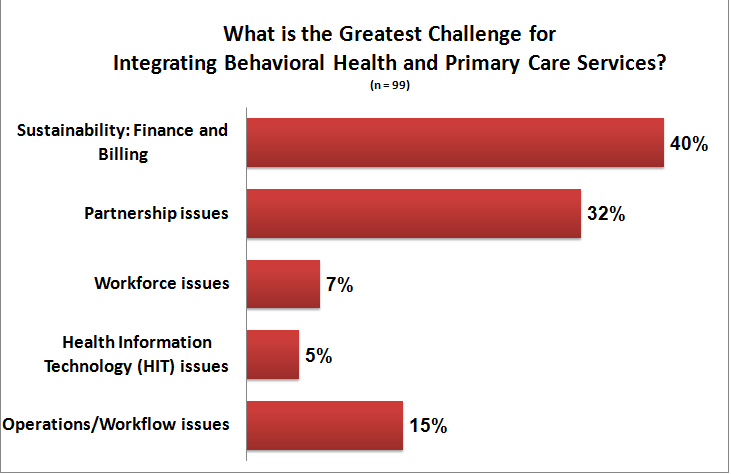
3/5/2012 – 3/5/2013
Finance and Billing
Poll responses indicated that sustainability issues related to finance and billing were the greatest challenge for integration efforts. While many providers have successfully overcome this barrier, it is no easy feat to develop a financially sustainable integrated services delivery system. Fortunately, the ACA created an optional Medicaid State Plan benefit for states to establish Health Homes to coordinate care for people with chronic conditions who receive Medicaid benefits. While only a handful signed on initially, there are currently 24 states and the District of Columbia who have elected to participate in the Medicaid Expansion. Fourteen states have elected not to participate; and 12 states remain undecided. (Click here for more information on where each state stands on ACA’s Medicaid expansion.)
States that are moving forward with Medicaid Health Homes are in the process of making adjustments to policies, billing, and service delivery to enable service providers to integrate behavioral health and primary care services, a requirement of Health Homes:
Partnership Issues
Regular visitors to this blog know that much has been published here about the partnership between behavioral health and primary care providers. This was ranked as second most challenging in the poll.
Why do so many people find partnership issues as challenging? It’s counterintuitive. Most providers approach the integration of behavioral health and primary care with a blind eye to the process of partnership development. It is assumed that the interpersonal aspects will fall into place. Unfortunately, it is far more likely that an integration effort will fail due to partnership issues than financial ones. They are not unlike other partnerships, requiring attention to building a strong foundation from the onset.
Here are additional resources:
- Successful Behavioral Health and Primary Care Partnerships
- For Better or for Worse: Honoring the Partnership in Behavioral Health and Primary Care Integration
Operations/Workflow Issues
All healthcare administrators acknowledge the importance of operations for successful service delivery. That’s why 15% of respondents to the poll indicated that this area is the greatest challenge. Once a smooth-running clinic takes on an entirely new service-line, a degree of disruption is inevitable. The workflow will likely be drastically different than the service providers and support staff have grown accustomed to. Of course, taking on a new service also means addressing the organization’s policies, regulatory requirements, physical space requirements, etc.
With a little careful planning and a LOT of patience, your new integrated clinic will be operating smoothly in no time. Click here for a useful integration planning checklist.
Workforce Issues
Seven percent of the respondents indicated that workforce is the greatest challenge. With the current shortage of primary care providers, nurses, and psychiatrists, it’s no wonder that this is of concern. Fortunately, programs for training about integrated care delivery are available, such as the University of Massachusetts Medical School’s Center for Integrated Primary Care, which offers three programs aimed at training healthcare providers for providing integrated services:
- Certificate Program in Primary Care Behavioral Health
- Certificate Program in Integrated Care Management
- Certificate of Intensive Training in Motivational Interviewing
Health Information Technology Issues
Despite concerns over the dilemma of sharing health records for integrating behavioral health and primary care, health information technology garnered 5% of the responses. Fortunately vendors of electronic health records are working earnestly to develop products that allow for the seamless sharing of behavioral health and primary care records. (Click here for more information on the role of HIT in integrated healthcare.)
One Year Later
What are the greatest challenges to integrating behavioral health and primary care in 2013? What will be the challenges next year? Dare we suggest that in the near future there will no longer be challenges?
Additional Resources:
- The Agency for Healthcare Research and Quality’s publication, Experts call for integrating mental health into primary care, provides additional useful information on addressing the barriers to integrated care.
- Integration of Behavioral Health and Primary Care: Preparing for Service Delivery
 Behavioral Health Integration