



Today marks the 50th anniversary of the date that President John F. Kennedy signed the 1963 Community Mental Health Act into law. It was to be the last before his death on 11/22/63. The Act represents a monumental turning point in the treatment of psychiatric disorders. President Kennedy’s call to action in 1963 was based on a belief that all Americans – including those with mental illnesses, intellectual disabilities, and addictions – have a right to lead dignified lives and to share in the benefits of our society. Patrick Kennedy, nephew of President Kennedy and former U.S. Representative of Rhode Island, is steadfast in his efforts to continue this important work via the Kennedy Forum.
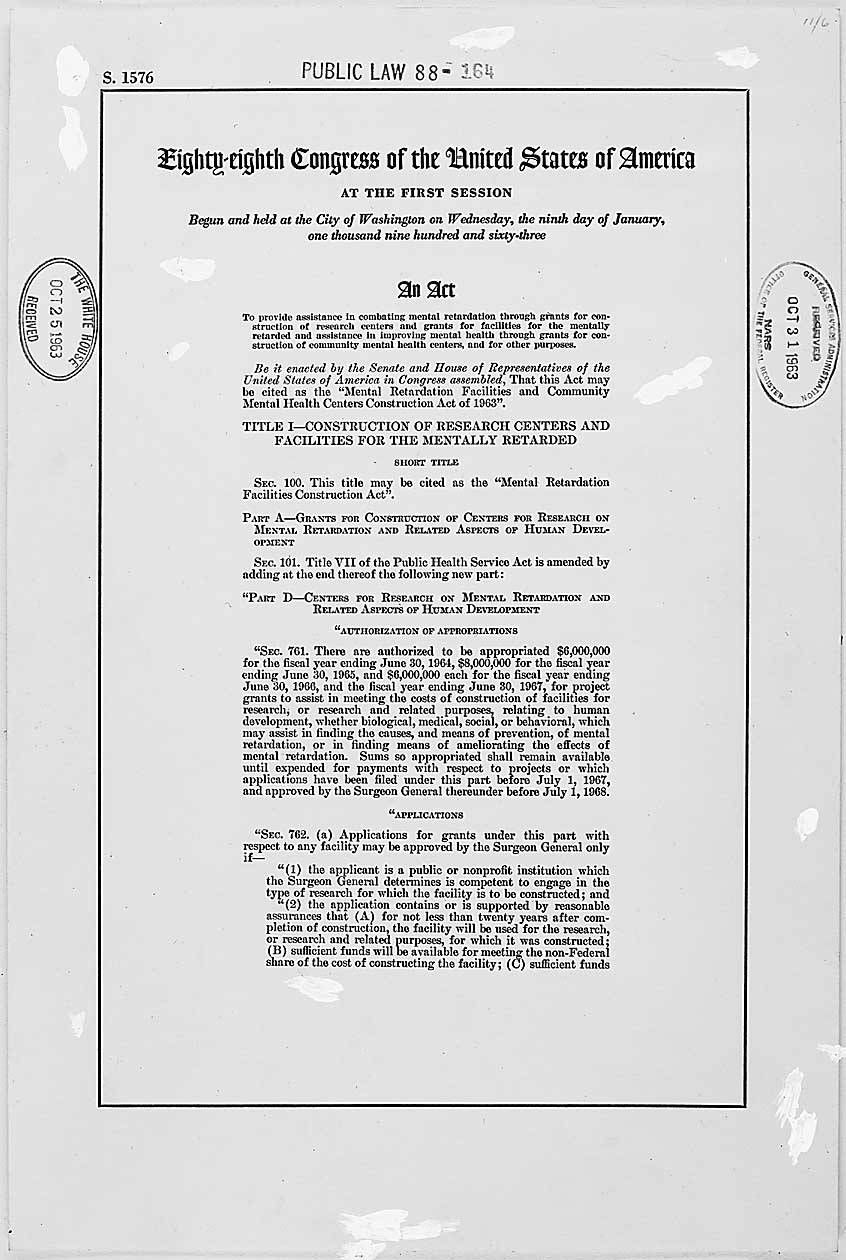
Act of October 31, 1963 “Mental Retardation Facilities and Community Mental Health Centers Construction Act of 1963”, Public Law 88-164, 77 STAT 282, “to provide assistance in combating mental retardation through grants for construction of research centers and grants for facilities for the mentally retarded and assistance in improving mental health through grants for construction of community mental health centers, and for other purposes.”, 10/31/1963 (Figure 1 below)
History of Psychiatric Treatment
Early attempts to treat mental illness are thought to date back to 5000 B.C. or earlier, based on the discovery of trephine skulls. A series of barbaric practices followed for millennia. It is suspected that the first asylums were established around the sixteenth century. These early facilities offered no real treatment despite their primitive attempts at cures, consisting of the use of leeches, purges, barbaric contraptions, and the use of chains and other restraints. Conditions gradually began to improve by the mid 1800s thanks to efforts led by humanitarians such as Dorothea Dix. Treatment reform in the asylums offered a more humane approach to the care of people with mental illness.
New treatment options followed in the early twentieth century, including psychoanalysis, introduced by Austrian neurologist, Sigmund Freud, and electroconvulsive therapy, introduced by Italian neuropsychiatrists, Ugo Cerletti and Lucio Bini. Psychopharmacology followed, arguably providing the single most significant change in treatment to date. A former colleague, psychiatrist, Dr. John Wolaver, remarked that when Thorazine was introduced in the psychiatric hospitals, the facilities were suddenly calm and quiet for the first time. It seemed to be a miracle cure. Psychopharmacology provided the next necessary step that led to deinstitutionalization.
The introduction of the Mental Retardation and Community Mental Health Centers Construction Act of 1963, Public Law 88-164, a bold new effort, forever changed the face of mental health treatment. Prior to this, it was not uncommon for individuals with behavioral health conditions to be hospitalized for many years; hundreds of thousands lived their lives in institutions and were buried on the grounds. Unfortunately, this deinstitutionalization effort fell short of its goal. The USA Today report, Kennedy’s Vision for Mental Health Never Realized, takes a candid look at this.
Figure 2 below illustrates the decrease in inpatient treatment between 1950 and 1995. As the psychiatric hospitals decreased in size, the homeless population grew. The jails and prisons began to fill with the individuals with behavioral health conditions. According to the 10/24/13 article, Why Are The Three Largest Mental Health Care Providers Jails? published by NewsOne: The three largest mental health providers in the nation are the following jails: Cook County in Illinois, Los Angeles County and Rikers Island in New York.

Integrated Care
Many thought-leaders believe that we have embarked upon another pivotal point in mental health (or more broadly, behavioral health) treatment. Mental Health: A Report of the Surgeon General published in 1999 called for the integration of behavioral health and primary care. And the 2006 NASMHPD report, Morbidity and Mortality in People with Serious Mental Illness has prompted the movement toward a whole health approach to treatment that integrates behavioral health and primary healthcare. This promising trend offers hope for improved access for individuals who live with mental health and/or substance use disorders, improved health outcomes, and controlling healthcare spending.
Let us work together to address health conditions wherever the individual presents for treatment. Healthcare must be redefined to include behavioral health. By removing the healthcare silos, providers will begin to recognize and treat the comorbid conditions in their patients. Mind-body integration improves patient outcomes and reduces costs.
Integrated care is necessary for improving the lives of of those who might have spent his or her life chained in a dungeon centuries ago. It is a key element in our efforts to achieve the Triple Aim.
 Behavioral Health Integration